International
School History - International Baccalaureate - MYP History
MYP4
Last
update -
09 November 2017
Unit 1 - Lesson 5 - Castles
and Cathedrals - Medieval architecture.
What
can medieval architecture tell us about medieval minds?
Go to
tripadvisor and look up 'things to do' in any
European city. Chances are, the main attraction is
likely to be church or a castle. Why? Part of the reason
is their sheer size. Medieval gothic cathedrals were
often the biggest structure in a city until the 20th
century. They are also very beautiful and they still
impress the visitor today. But perhaps more than
anything, is that they stand as a record of human
achievement that has, quite literally, stood the test of
time.
Why important?
It is helpful to consider the concept
of historical significance as outlined by Rob Phillips.
He argued events were important for four reasons:
Profundity: Refers to how
deeply people were/have been affected by the event. How
deeply were people's lives affected?
Quantity: Refers to the number of people affected by
the event. Did the event affect many, everyone, just a
few? Were the effects widespread or localised?
Durability: Refers to how long
were people affected by the event. How durable was the
event in time? Was the event lasting or only ephemeral?
Relevance: Is the event
relevant to our understanding of the past and/or
present? Does the event carry any meaning to historians
today.
On each of the four indicators of
significance, castles and cathedrals, clearly tick every
box. But they are also important to historians because
they provide rare, accessible, unmediated access to the
past. You can walk in the footsteps of our ancestors and
relive the past. You can touch the stones, look out at the same
views and imagine what it would have been like in the
past. History
is a social science but also an art. The built past
helps us empathise with those who lived that past.
Finally, I hope that in learning about
medieval architecture, you will begin to make sense of
the world around you. It is hard to find any subject
interesting, if it is written in a foreign language.
Buildings have their own vocabulary which talk to us:
about function and aesthetics, beliefs and skills.
Without this vocabulary, medieval buildings are simply
piles of old stones.
In this lesson we are going to explore
how and why castles and cathedrals were built, how and
why they changed over time and what this can tell us
about the minds of those who built them, those were were
controlled by them and those that tried to destroy them.
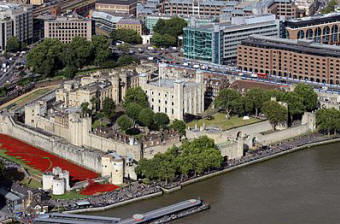
The Tower of London
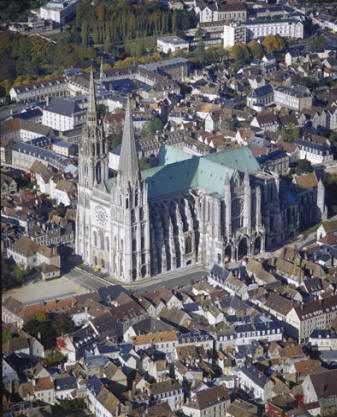
Amiens Cathedral, France
Medieval Castles
A castle is
a defensive structure associated with the Middle Ages,
found in Europe and the Middle East. The word "Castle"
is derived from the Latin word castellum. The French
château, Spanish castillo, Italian castello derive from
castellum. The word castle was introduced into English
shortly before the Norman Conquest (1066) to denote this
type of building, which was then new to England. The
precise meaning is usually considered to be the "private
fortified residence" of a lord or noble. This is
distinct from a fortress, which was not a home, or a
fortified town, which was a public defence.
A European innovation, castles originated in the 9th and
10th centuries, after the fall of the Carolingian Empire
resulted in its territory being divided among individual
lords and princes. Castles controlled the area
immediately surrounding them, and were both offensive
and defensive structures; they provided a base from
which raids could be launched as well as protection from
enemies. They also served as centres of administration
and symbols of power. Urban castles were used to control
the local people and important travel routes, and rural
castles were often built near natural features that were
important to life in the community, such as fertile
land.
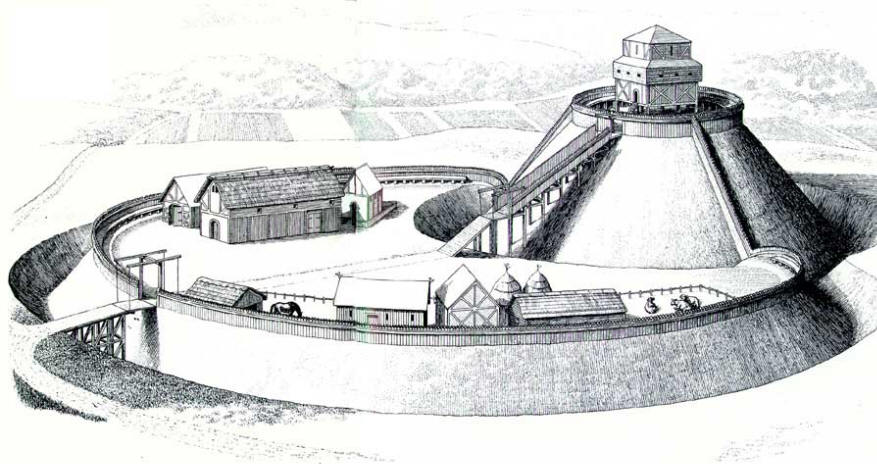
Many castles were originally built from earth and timber
(wood); these are known as motte and bailey castles.
They were relatively quick to build (as little as one
week) and could be made with easily found materials. A
motte was an earthen mound with a flat top. The excavation of
earth for the mound left a ditch around the motte, which
acted as a further defence. Sometimes a nearby stream
was diverted to flood the ditch, creating a moat. Motte
refers to the mound alone, but on top of the motte was
often a fortified structure, such as a keep, and the
flat top would be surrounded by a palisade. It was
common for the motte to be accessed via a flying bridge
(a bridge over the ditch from the counterscarp of the
ditch around the motte to the edge of the top of the
mound), as represented by the Bayeux Tapestry's
depiction of Château de Dinan. (right - click on the
picture to see a close-up)
A bailey, also called a ward, was a fortified enclosure.
It was a common feature of castles, and most had at
least one. The keep on top of the motte was the home of
the lord in charge of the castle and a bastion of last
defence, while the bailey was the home of the rest of
the lord's household and gave them protection. The
barracks for the garrison, stables, workshops, and
storage facilities were often found in the bailey. Motte and
bailey castles were
relatively weak and uncomfortable places to live, so if
the location of the castle was important enough it would
gradually be replaced with a stone structure. Typically
either a square stone keep would be built or a circular
wall would replace the wooden stockade (palisade) to
form a shell keep castle.
The stone
keep or donjon became a key feature of castle
development from the 12th century. With walls up to four
metres thick and space to provide comfortable living
quarters for the lord, the stone keep became common
across Europe. In the late 12th and early 13th
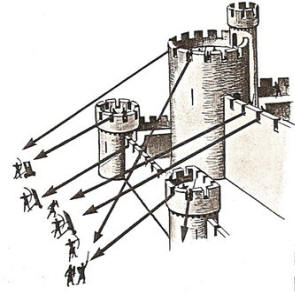
centuries, a scientific approach to castle defence
emerged. This led to the proliferation of towers, with
an emphasis on flanking fire. Many new castles were
polygonal or relied on concentric defence – several
stages of defence within each other that could all
function at the same time to maximise the castle's
firepower. The
origin of these changes in defence has been attributed
to the Crusades, as European's came into contact with
Arab castle technology.
The most
common means of attacking a castle was to lay siege to
it. This meant preventing supplies and people coming out
of the castle. In one of the most famous sieges of the
Middle Ages, the Siege of Acre during the Third Crusade
lasted from August 1189 until July 1191. The only
significant development in the attack of castles was the
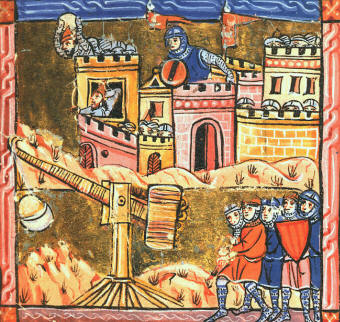
development of the trebuchet, which again came from the
middle east. In 1304, King Edward I lay siege to
Stirling castle in Scotland with what was said to be the
biggest trebuchet ever built, 'Warwolf'. It took five
master carpenters and a team of labourers three months
to put together. A
recent TV documentary reconstructed the siege and
built a trebuchet, using medieval techniques, capable
destroying the castle walls.
Contemporary depiction of a trebuchet at
the Siege of Acre.
Biblotheque Municipale de Lyon
Powerful
video
reconstructing a medieval siege from the feature film Kingdom of
Heaven (password 'bisb'). How accurate is the film? See Alex von Tunzelmann's
review.
Concentric castles would take a long time to build and
were very expensive. Beaumaris Castle in Wales, has
surviving records from 1295–96 which describe 200
quarrymen, 400 stonemasons and as many as 2000 minor
workmen. For example, costs for Beaumaris, were £14,500
(roughly 20 million Euros in today's money). Work
started in 1295 and continued for 35 years and it was
never completed.
Gunpowder, introduced to Europe in the 14th century, did
not have an immediate impact on castle building. Castles
were not adapted to resist bombardment by cannons until
the 15th century, when artillery became powerful enough
to break down stone walls. Although castles were built
across Europe well into the 16th century, new techniques
to deal with improved cannon-fire eventually led to them
becoming uncomfortable and undesirable places to live.
Activity 1
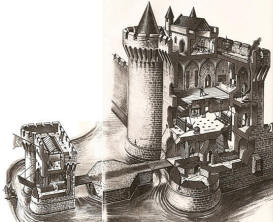
Make a copy of the diagram of a motte
and bailey castle. Add labels to each of the key
features.
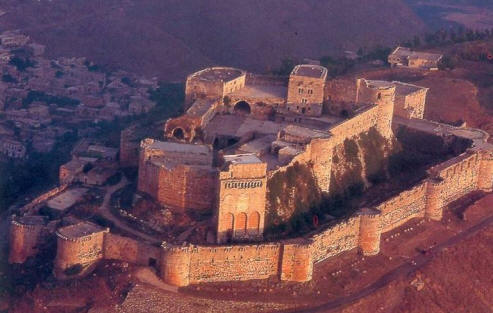
Examine the defensive features of the
Swiss medieval castle of
Chillon. Explain why this castle would have been so
difficult to attack. Rather that simply listing the
relevant defensive features, it is important you explain
carefully how each defensive feature functions.
Medieval church architecture
Before we look at the role and importance
of the medieval church, we are first going to look at
the buildings they left behind. The medieval church
building was not merely a place of worship, it was a
site where consecrated stones, with the help of a priest
and holy relics, could transform ordinary bread and wine
into the body and blood of Jesus. (transubstantiation)
But the building was also an expression of the political
power of the church. The sheer size and weight of
the church were meant to leave people awestruck. These
great cathedrals often took two or three generations to
complete. The
ideal church was meant to appear as if it was heaven on earth.
As the power and importance of the church
increased during the Middle Ages, so the architecture of
church buildings sought to reflect this power. The key
innovation was the development of gothic. On 11 June
1144 in the presence of the French King at Basilica of
St Denis, outside Paris, Abbot Suger revealed a new
architectural style, that though the use of the ribbed
vault and the pointed arches brought light to the heart
of the church. It was an architectural revolution. See
Khan Academy on this.
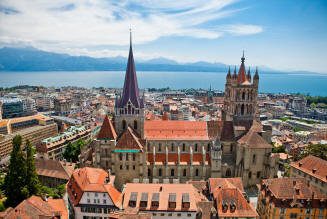
Lausanne Gothic cathedral 1165-1275
The largest church in Switzerland
Activity 2
Using the
PowerPoint and film above, explain in your own words the
main differences between Romanesque and Gothic styles.
You should illustrate your explanations with images you
have researched.
Download the floor plan of
Amiens Cathedral. Research the various features of
the medieval cathedral and add them with descriptions to
the plan. You might want to start with a
Khan Academy tour of Amiens.
And finally, just to see how much you have learnt.