International
School History - International Baccalaureate - MYP History
MYP4
Last
update -
11 March 2018
Unit 1 - Lesson 6 - The Power
and Importance of the Medieval Church
In 313 AD
Emperor Constantine issued the Edict of Milan, which
accepted Christianity in the Roman Empire. Eventually it
became the official religion. With the breakup of the
Roman Empire, Christianity survived and through the work
of missionaries and monks it began to spread north.
With the collapse of Roman cultural
institutions, monasteries became the most
important centres of learning. The most important
contribution by monks to medieval society, was as
librarians and scribes. The whole of western learning
was contained in the precious books (manuscripts)
chained to libraries of European monasteries and
meticulously copied by hand by monks in the scriptorium.
Knowledge is power. Control over what can be known and
control over what is worth knowing and what should be
known, gave the church - via- the monks - enormous
influence over the medieval world.
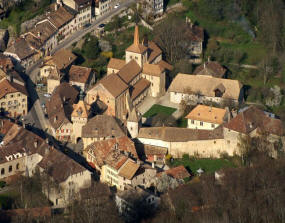
Romainmôtier Priory
in Vaud, is the oldest Christian site
in Switzerland. It was established by monks in the 5th
century.
The
idea of monasticism within Christianity had come from
the Roman period when individual men went to desert
areas in Egypt to lead a solitary life of meditation and
fasting. The word 'mon' from monk and monasticism,
comes from the ancient Greek and means This idea gradually spread to Western
Europe and monks there followed the rules established by
St Benedict of Nursia who lived from 480 to 547.
Some monasteries were established next
to cathedrals in large towns, others were built in wild,
remote areas where the harsh landscape would mean that
the monks had to work hard to become self-sufficient.
These monks believed in isolation from the corrupt
world, and total poverty, humility and obedience became
central beliefs. Monks would leave society for work and
study; there would be no time for entertainment or
selfish actions. A peaceful, almost silent life would
enable them to focus on serving God.
In the early Middle Ages, boys were sometimes given to
monasteries at a young age, as a gesture of a family's
faith. By the twelfth century joining a monastery was
voluntary and, although boys as young as ten years old
sometimes joined a monastery, they could leave before
they took their holy vows if they did not want to stay.
Boys aged 15 years or older, with a religious calling,
would become trainee monks, called novices. They would
help the other monks, sing in choir and study, being
taught to read and write by older monks. They would be
supervised by the Master of the Novices for at least a
year. The master had to check that the novices were
suitable for monastic life.
Taking their vows would mean that they
pledged themselves to a life of poverty, obedience and
humility, including chastity and a commitment to
monastic life. They could not leave the monastery
without the permission of the Abbott. When they took
their vows, monks would be given a tonsure - their hair
would be cut and shaved leaving only a circle, to
represent the crown of thorns of Jesus. Young monks would
then train to become fully-fledged 'choir monks' and would
follow the rules of the monastery closely.
St Benedict's Rule
St Benedict's
Rule gave all medieval monasteries their basic
code of behaviour.
• clothing
• giving up personal possessions
• sleeping arrangements in dormitories
• vegetarian diet with descriptions of portions
and types of food allowed
• the treatment of guests in guest houses
• the importance of caring for the sick in
specially built infirmaries and silence in the
monastery.
'Idleness is the enemy of the soul. Therefore, at
given times the brethren ought to be occupied in
manual labour, and again at other times in
prayerful reading... A mattress, woollen blanket
and pillow is enough for bedding. All monks
should take it in turns to wait on each other so
that no one is excused kitchen work.'
Extract from St Benedict's Rule.
St Benedict also
wrote down the suggested structure of each day.
• Prime: service at dawn, or 6 am in summer.
• Wash in the cloister wash basins, then
breakfast unless fasting.
• Terce: 9 am service including mass.
• Meeting in the chapter house or meeting room,
to give out daily tasks, hear confession, issue
punishments.
• Work (copying, in the kitchen, gardening,
teaching, caring for the ill, in the guesthouse
or on the farm).
• Sext: midday service including mass.
• Dinner then private reading, then work.
• None: 3 pm service followed by a short rest.
• Vespers: 4.30 pm service.
• Wash for supper.
• Compline: dusk/6 pm service.Bed until
midnight.
• Matins/Lauds: midnight service.
• Sleep again until Prime.
The spread
of monasticism
As monastic
life became more popular in the religious age of the
Middle Ages, the size, wealth and power of monasteries
also grew. The original type of monastery was the
Benedictine order, which included several independent
abbeys. Some monasteries differed in their
interpretation of St Benedict's Rule and new orders
(types) of monastery were established. Many of these new
orders wanted to reform monasticism because they felt
that it had relaxed and moved away from its original
austerity (strictness). For example, many monasteries
included monks that were called 'lay brothers';
distinguished from 'choir monks', lay brothers did most
of the manual chores around the monastery.
The first
new order to challenge the Benedictine order was that of
the Cluniacs, from Cluny in Burgundy, France. The
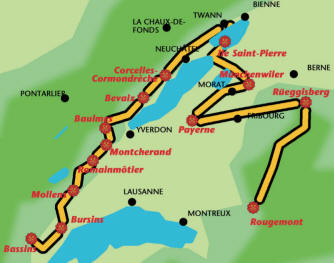
Cluniacs were particularly important in Vaud with a
series of monastic houses established around Lakes
Neuchâtel and Geneva. The local village of
Bursins had a Cluniac order from 1011 until the
Reformation. Several other orders had developed by the
thirteenth century, including the Cistercians,
Carthusians, Franciscans and Dominicans (see table
above). So many different orders existed that by 1215
the Pope resorted to banning any new orders; new
monasteries had to adopt one of the existing orders.
Order
Foundation
Aims
Details
Cluniac
Cluny,
France
To lead a strict life and be more centralised in
their organisation
Became large and wealthy; criticised by the
Cistercians for their elaborate buildings and
rituals.
Cistercian
Citeaux, France
To lead a more holy life
Included choir monks and lay brothers who were
not educated but took vows and worked as
labourers; undyed woollen habits gave them name
of 'White Monks'.
Franciscan
St Francis of Assisi
To live in poverty
Became the 'Friars'; they travelled the world
preaching and begging for their food, totally
rejecting any worldly possessions and wealth
Dominicans
Spanish priest Dominic de Guzman
To live in total poverty but as educated men
Called 'Blackfriars' because of their black
woollen habits (robes)
Carthusian
St Bruno of Grenoble
To live a solitary life keeping strictly to vows
Lived in individual cells and spent most time
there praying and studying; most strict of all
the orders
Activity 1
Read the text above and watch the film
by Terry Jones, 'The paradox of monasticism' and then answer the following questions:
1. Monasteries contained libraries and
scriptoria. Why was this important?
2. What were the basic principles of
St Benedict's rule and why would men become monks?
3. In what ways did monastic orders become corrupted and
why did new monastic orders appear?
4. What does Terry Jones mean by the 'paradox of
monasticism'?
As we have
seen, in the
middle ages, belief, religion, power and politics were
closely interlinked. Rulers ruled and people obeyed,
because that is what God wanted. Kings were appointed by
God; they were kings by 'God's grace', who had a 'divine
right' to rule. In return for this spiritual support,
the kings protected the church. The most important
direct power the church exercised over people came
through the church (ecclesiastical) courts. Unlike the
manorial and royal courts which dealt with more
traditional crimes and punishments, ecclesiastical
courts dealt with moral matters and what was socially
unacceptable to the church. Ecclesiastical courts were
also known as 'bawdy courts' because of the licentious
nature of the content. Watch the following video to get
an idea of the sort of cases ecclesiastical courts would
hear.
The content of the court records
can be very revealing about everyday life in medieval
Europe. They might deal with any range of issues,
ranging from marriage disputes and sexual misbehaviour,
to land disputes and non-payment of tithes (see below).
Although church courts could not sentence anyone to
death, they could sentence someone to make penance -
e.g. to go on a pilgrimage, to fast etc. - or in
most extreme cases, the court sentence someone to
excommunication. Excommunication meant you would not be
allowed to take communion anymore (see below). If
you were excommunicated you would not go to Heaven
after the Last Judgment and in addition you would be an
outcast in society. Even your parents and your
children were not supposed to talk to you or let you in
their house.
For more about the
church courts see this
BBC article.
The church
and the economy
There were
also strong economic ties between the church and the
people. All land that did not already belong to the church was taxed for the benefit of the
church. One
tenth (a tithe) of everything produced on this land was
given to the church. In addition, the church itself did
not pay taxes on anything donated to it. People, who
wanted a saint to produce a miracle, were expected to
make an offering to the saint's church. As a
consequence, the church became very rich. By the end of
the middle ages, the church owned approximately one
third of all the farmed land in Catholic Europe!
The church
and society
The church
also strictly controlled people's everyday life.
Everyone belonged to their local parish. From managing
the important civic ceremonies of birth, marriage and
death, to organizing the festivals associated with Holy
days, the church was responsible for all aspects of
village social life.
Most importantly, the parishioner
attended a weekly Sunday communion (Mass or Eucharist) and regularly
told the priest all their most personal secrets
(Confession).
In 1215, Pope Innocent III, had
decreed that all Christians must confess their sins at
least once a year. Mass and Confession were part of the
Seven Sacraments, seven ceremonies that the church
controlled and which controlled in turn the lives of all
Christians.
The Church
and culture: the influence of the Church
Politically,
economically and socially, the church exercised an
all-embracing, 'Catholic' influence, but it was the
cultural influence that was most important of all. Power was
important, but the church's influence went beyond the
physical control of people's lives. By
controlling the minds of medieval men and women, by
influencing how people explained what happened to them,
the Church had no need to physically force people to do
anything.
Medieval people were fatalists. They believed
that everything happened because God wanted it to
happen. Nothing happened naturally, everything happened
because of 'divine intervention' (God's actions). When
good things happened, people were being rewarded by God
and they thanked him. When bad things happened, they
were being punished for doing something sinful. Medieval
people were constantly on the lookout for signs or omens
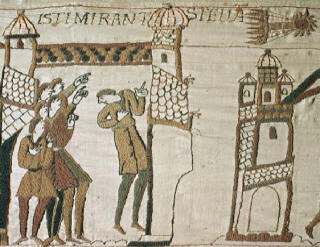
of God's moods. For the people of Paris, a red sky at
night three times in a row was a sign of war; the
appearance of Halley's Comet in 1066 was shown on the
Bayeux Tapestry (right), as an omen or portent of great
upheavals to come.
In a largely illiterate society, the most effective
means of communication was necessarily visual. In
addition, the church services were conducted in Latin,
which whilst contributing to the awe inspiring,
mysticism of the ritual, also meant that the church
could not convey a message through the spoken word.
Instead, to get its message across to the masses, the
church relied on the visual arts.
The artistic canvas of the church was
the physical space of the church itself. Through the
sculptures on the building itself, walls covered with
brightly coloured paintings and the magnificent
stained-glass windows, the church told the stories it
wanted the people to hear. The Bible was the source for
many of the stories; the life of Jesus and the saints,
the Fall (Adam and Eve) and Second coming of Jesus and
final judgement of the apocalypse (see below).
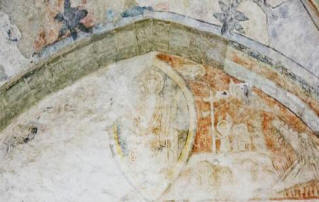
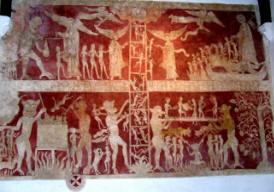
The last judgement - The chapel at
château de Chillon
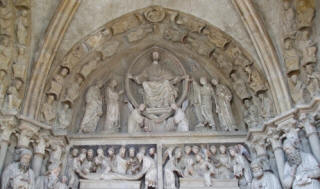
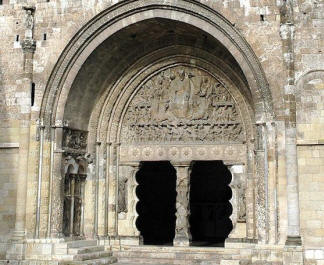
The
tympanum.
As you enter a church, above your head, is often a
tympanum, a semi-circular or triangular surface covered
with sculpture and images, between an arch above and
lintel below.
The Tympanum - Lausanne Cathedral
The Tympanum - Moissac, France.
Stained
glass windows
As a material
stained glass is glass that has been coloured by adding
metallic salts during its manufacture. The coloured
glass is crafted into stained glass windows in which
small pieces of glass are arranged to form patterns or
pictures, held together (traditionally) by strips of
lead and supported by a rigid frame.
Paintings
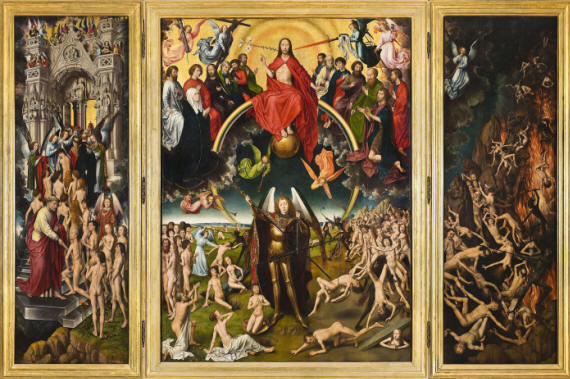
Dooms paintings were used to remind
medieval Christians of the afterlife and Judgment Day,
and to help keep them aware of sin, by showing in
graphic detail the dramatic difference between Heaven
and Hell.
A Doom painting was usually sited at the front (Chancel
end) of a church, often on the Chancel arch itself, so
that it would be constantly in view of worshippers as
they looked towards the priest during services. This was
a very effective method of control of the illiterate
mass who could not read the Latin Bible or understand
the Latin the priest was preaching. An alternative way
of conveying the message would be through a painted
altarpiece that would be placed on or behind the altar.
Hans Memling's Last Judgement, c. late
1460s, National Museum, Gdańsk (Enlarge)
Paintings
of the seven deadly sins were another common medieval
art form. The seven deadly sins, also known as the
capital vices or cardinal sins, is a grouping and
classification of vices. According
to the standard list, they are pride, greed, lust, envy,
gluttony, wrath and sloth. Each of these vices had
dedicated punishment awaiting the sinner in hell. Below
is my favourite example from Albi, in the south of
France. It is probably the biggest doom painting in the
world. For help with the interpretation, have a look at
this
worksheet.
And one final artistic image of the
Seven Deadly Sins, from the late Middle Ages attributed
to Hieronymus Bosch
Activity 2
The medieval
church controlled people politically, economically,
socially and culturally. Using this
template as a basis, complete an essay plan that
provides a PEE structure to four paragraphs about the
control of the medieval church.