International
School History - International Baccalaureate - MYP History
MYP4
Last
update -
09 November 2017
Unit 1 - Lesson 2 - How was
the medieval state different to the modern?
What is a state?
A state is more than a government. The difference
between state and government is like the difference
between weather and climate. Governments come and go,
but states remain. A state is an established means of
rule over a bordered or ‘sovereign’ territory and the
people that live there.
How the state rules over its people depends on the type
of government and state’s constitution. The constitution
is an established set of rules which govern how the
state should operate. Representative democracy is a
modern type of government (demos = people), where the
people are citizens who participate in the
decision-making process and who have equal rights (to
vote, to freedom of speech, to a fair trial etc.)
guaranteed by a bill of rights, that is built into the
constitution.
In a medieval monarchy (mono = one), the people are
subjects of a king or queen, with rights of
participation dependent of their ‘station’ or social
standing. The aristocracy (rule of best) who owned lots
of land were very powerful; the landless peasants had
little or no rights at all.
A modern democratic state has an executive, a
legislature and a judiciary. In the UK, the executive
(Prime Minister and Cabinet) proposes laws, the
legislature (Houses of Parliament) debates and amends
these laws and judiciary (Supreme Court) decides whether
the new laws are allowed by the constitution. In a
modern democratic state, the people who exercise power
in these institutions have usually been chosen by the
citizens through election. See the Jay Foreman
video on this.
In the US, the three branches of government look like
this:
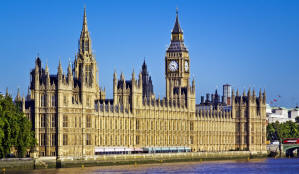
The Houses of Parliament in London look
medieval,
but were actually built in the 19th century.
Three parts of the state are deliberately separated to
stop any one part from becoming too powerful. A modern
democratic government is a collection of individuals,
usually member of the same political party, which has
been chosen by the people, to temporarily run the state.
This is an important responsibility because a state
raises taxes and operates a police force and they
distribute and re-distribute resources and wealth. The
state has authority to control us and make us do what is
in the interest of the state, even if this means going
to war against other states. There are three ways
through which the state controls the individual, through
using coercion, persuasion and by generating consent.
Firstly, an individual agrees to be governed by the
state, they give their consent to be governed,
when they rationally accept the right of the state to
govern their actions. They accept that the state has authority over
them and that it is in their interest to obey the
state. For example, I
agree to pay my taxes because that allows the state to
pay for rubbish disposal.
Secondly, an individual may also obey the state because
of the powerful mechanisms of persuasion the
state is able to employ. As long as the state controls
its education system it will have a powerful way of influencing how
its citizens think. For
example, if I study my national history in school, I
will feel more patriotic.
Finally, states are defined as having a
'monopoly of the legitimate use of force'. (Weber) An
individual will obey the state because they fear the power of
the agencies of state coercion: the police, the
courts, the army etc. For
example, I will not break the law (even if I feel a law
is wrong) because if I do, I might be imprisoned.
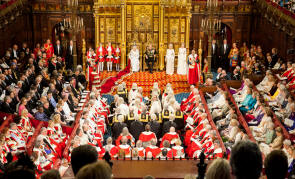
The state opening of parliament in the UK
How the state exercises control can be summarised in a
table:
Coercion
Persuasion
Consent
Power
The government has power if it
can coerce or force an individual to act against
their will, e.g. imprisonment.
Influence
A government has influence
when people’s behaviour can be deliberately
directed without their conscious awareness of
this direction, e.g. education.
Authority
A government has authority when
people accept that the government has the right
to control their actions, e.g. elections.
All states use coercion, persuasion
and consent to control the individual, but the modern
democratic derives its authority (and has legitimacy)
because the citizens have consented to be governed
through elections. There were no elections in the
medieval state, so government depended much more on
coercive power and persuasive influence. Much of what we
are going to study over the next two years, is concerned
with how our modern democratic states came into being;
how it evolved from the absolute monarchies that
dominated the medieval world.
Activity
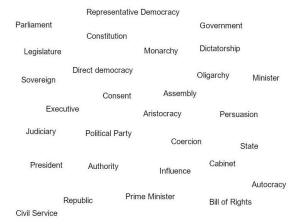
1. Visit
http://express.smarttech.com. Download and save this
Smartnote file
state_words to your computer. Click on 'Open an
existing Notebook file' and choose the 'state-words'
file you have saved.
a) For words you definitely understand
and can define, change the colour of the word to green.
Those words you think you understand, colour orange, and
those you do not understand colour red.
b) Rearrange all the words into three groups. Group 1 -
words that are types of states. Group 2 - words that are
state institutions. Group three - words that are
concepts associated with states.
2. Describe the main differences
between the medieval feudal state and the modern
democratic state.
3. Define and learn the following
political concepts: state, constitution, executive,
legislature, judiciary.
4. Explain the difference between
power, influence and authority by using an example for
each which excludes the other two, i.e. give an example
of someone or something that has power but neither
influence nor authority.