International
School History - International Baccalaureate - MYP History
MYP4
Last
update -
08 January 2018
Unit 2 - Lesson 4 - The
age of exploration
Why did the Spanish conquer the Aztecs and Incas and
not the other way around?
‘A historian who had lived at any time
between 8500 B.C. and A.D. 1450, and who had tried then
to predict future historical trajectories, would surely
have labelled Europe's eventual dominance as the least
likely outcome, because Europe was the most backward of
those three Old World regions for most of those 10,000
years.’ Jared Diamond
And yet the world we live in today is a European world,
a world which has been shaped by European ideas and
systems, inventions and innovations. The last 500 years
or so have seen Europeans and their decedents in the
Americas and around the world, dominate trade and
conquer through war, virtually the whole of the globe.
Until very recently, in the last 10-20 years or so, it
was hard to imagine a future that wasn’t dominated by
Europeans. But as the history of previous great
civilisations and empires shows us, the rise of empire
has always been accompanied by a fall.
The great question of 1450 is why was Europe on the
verge of world domination? Why did the Spanish conquer
the Aztecs and Incas and not the other way around? In
1450, Europe was not yet the most advanced global
civilisation. In 1450, that would be China. China had
invented paper, printing, gunpowder, compasses and the
mechanical clock. For more on Chinese achievements see
this
video and 20 Chinese
inventions.
When the Portuguese explorer Vasco de Gama first
explored the East African coast (see below), the natives mistook him
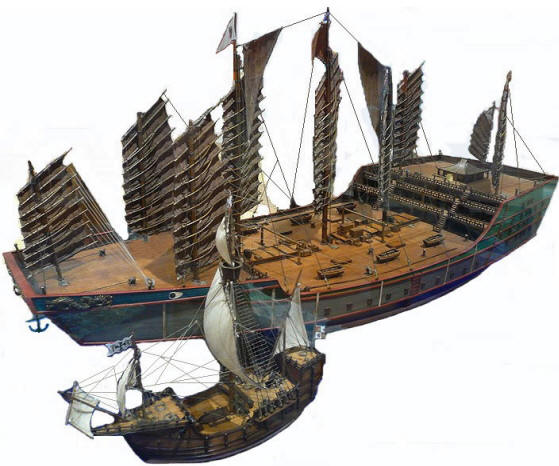
as Chinese. The great Ming-dynasty sailor Zheng He had
been in Africa a generation before. In the 1400s, China
owned the greatest seagoing fleet in the world, up to
3,500 ships at its peak. (The U.S. Navy today has only
430). Between 1405 and 1433 seven Chinese ‘treasure
voyages’ were undertaken that used ships and technology
well in advance of European navigation and 27,000
sailors, larger than the population of most European
medieval towns. The motivation was different to European
motivation. This was not exploration, China already knew
about the places Zheng He visited. Nor was it about
trade. China was already at the centre of trade and was
self-sufficient. The ‘treasure voyages’ were a show of
strength and a personal project of one Chinese emperor,
Yongle. After his death, there was little interest in
further voyages. Would the history of the world have
been different if Vasco de Gama's four little Portuguese
caravels had run into a fleet of more than 250 Chinese
ships of various sizes, but all of them larger than the
Portuguese flagship?
In the fifteenth century Italy was well positioned to
become a key centre for European trade with the east,
because it attracted many scholars, bankers, merchants
and trades people. It became the banking centre of
Europe and the rest of the known world. As these people
prospered, so did the Italian city states such as
Venice, Milan and Florence. Successful traders wanted
the best for themselves, their families, and their towns
and cities. They had the money to buy beautiful things
and support the arts. Wealthy families acted as sponsors
to scholars and artists, providing them with work and a
living, so cities such as Florence became centres of
Renaissance learning and the arts. As we have seen, trade was not limited to Europe alone. For Europeans,
the East - countries such as India and China - was seen
as a great mystery and exciting and the goods to be
found there were much in demand. For example, cottons,
silks and delicately coloured porcelain were much sought
after in Europe. The search for gold spurred explorers
to go to far-flung places. By the end of the fifteenth
century there was not enough gold in Europe to satisfy
the needs of the rich and wealthy.
At this time knowledge of the world was rapidly
expanding as people journeyed more and new peoples and
cultures were discovered. This process was aided by
recent inventions like the compass, logline and maps.
Why did voyages of discovery take place? There are a
number of factors, namely:
• the desire for trade
• proselytizing (spreading Christianity)
• the desire for increased wealth and power
• the desire for adventure to discover the unknown
• technical advances (now it was possible)
• empire building and to establish control over other
countries.
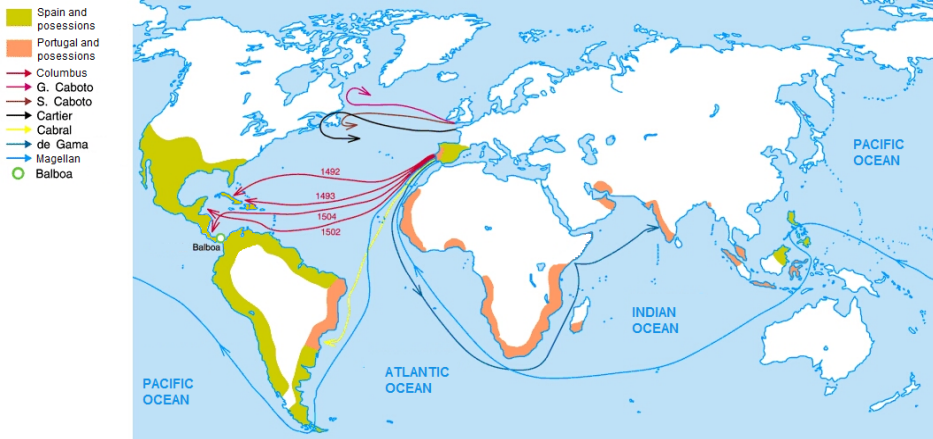
Spain and Portugal were the great naval powers in the
fifteenth and sixteenth centuries; they wanted to
enlarge their empires. They led the way in exploration
with Christopher Columbus (1451-1506) discovering the
islands of the Caribbean - the West Indies - in 1492.
Other than Vasco da Gama
(1460-1524), another Portuguese explorer Ferdinand Magellan (1480-1521)
was the first to circumnavigate (sail around) the Earth (1519-1522). Magellan also
named the Pacific Ocean. See a documentary about
Magellan's circumnavigation
here. Amerigo Vespucci (1454-1512)
was an Italian explorer who was the first person to
realize that the Americas were separate from the
continent of Asia. America was named for him in 1507.
Activity 1 - Vasco de Gama and Spice
Watch the video and consider the list
of factors that explain why the voyages of discovery
took place. Which factors were relevant to Vasco de
Gama's voyages to India? It is important that you refer
to historical details from the film in your answer.
What was sea travel like in the 15th century?
Travelling to the East presented an exciting challenge
to Renaissance explorers, but what was the East actually
like at this time? Europeans had a good idea what China
was like because the thirteenth-century explorer Marco
Polo (c. 1254-1324) had been there and had written about
its wealth and riches. They also knew about India, or
the Indies, but were not sure of the exact location.
They were confident about the luxury goods they would
find there and there were stories of a mountain of gold.
They had also heard stories about strange peoples and
fearful monsters.
For centuries, European sailors never ventured far from
land so that they wouldn't lose sight of familiar
landmarks. In the open sea it was vitally important to
be able to navigate effectively because accurate maps
did not exist. Dead reckoning was used by sailors, which
meant that a compass told them what direction they were
going in and a logline allowed them to make a rough
calculation as to their speed. This logline was a piece
of wood with a rope attached to it. On the rope knots
were made at regular intervals. When the wood was thrown
into the sea, the rope would unwind as the ship sailed
forward and, by counting the knots, sailors could make a
rough calculation of their speed. A knot is still used
today as a nautical term for miles per hour. Sailors
would also use a cross-staff or quadrant as a further
check to measure the position of the pole star and other
stars in relation to the horizon.
The explorers used ships called caravels. They could
travel quite quickly because the big sails caught the
wind well and the triangular lateen sail at the back
made it easy to tack (move in a zig-zag direction) when
sailing directly into the wind. These ships were set
deep enough into the water so they didn't capsize
easily. They were just large enough (approximately 21
metres long and 6.5 metres wide) to take the crew needed
to deal with all the complicated rigging, the necessary
stores and the guns, which could be fired through the
ports (holes) cut into the high sides.
One problem, which was never really solved by the
explorers, was how to keep the crew healthy. The crew
had to put up with many hardships and dreadful
conditions whilst on board ship. Below decks it was very
cramped, dirty and dark; often the sleeping space was
not much more than a metre high; rats and lice were
common-place. In bad weather, water seeped in through
the wooden planks and it was not possible for the
sailors to go on to the open deck; the work was
extremely dangerous because adjusting the sails in a
storm was a hazardous operation. In a dead calm, on the
other hand, the crew soon became bored because there was
nothing to do to keep them occupied. As the ship was
made from wood, fire was a constant risk and a sailor's
diet became worse and worse as the long journey
progressed. Hot food was cooked on a fire in a box of
sand, when the weather allowed. However, water stored in
barrels soon went off and wine turned sour. Food also
went stale and rotted or the ship's biscuits became
infected with weevils. Lack of fresh fruit and
vegetables meant sailors often suffered from diseases
such as scurvy caused by a lack of vitamin C. When they went to places where no other
Europeans had been before it was dangerous to land and
restock with food and water because the inhabitants
might be hostile.
'Food does not keep well, no one washes, no one shaves.
It is almost impossible to keep anything dry in a storm,
and you can expect to be wet and miserable most of the
time. The cabins stink of urine, faeces and vomit, not
to mention the smell of rat urine. They also tend to get
unbearably hot in summer. You may also be woken by the
constant noise of the waves. In high seas the timbers
grind against one another, as if the ship is trying to
wrench itself apart. If you are stuck on such a vessel
for several weeks, then nerves and tempers wear thin.
Men get rowdy, get drunk and fights often break out.'
Ian Mortimer – The Time Traveller’s Guide to the Middle
Ages, 2008.
Activity 2 - Sea Travel in the 15th Century
1. Identify at least two reasons why the
film extract from 1492 might not be historically
accurate.
2. List five reasons why sea travel was so difficult in
the 15th century.
Consequences
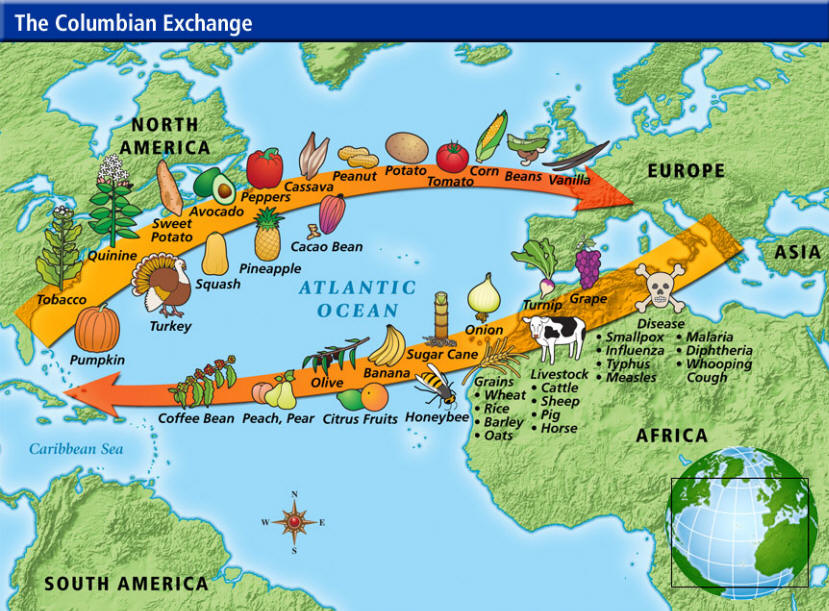
European overseas expansion led to the contact between
the Old and New Worlds producing the Columbian Exchange,
named after Columbus. It involved the transfer of goods
unique to one hemisphere to another. Europeans brought
cattle, horses, and sheep to the New World and from the
New World Europeans received tobacco, potatoes and
maize.
Massive profit could be made by those who risked money
on investing in explorers and trading adventurers.
Investors joined together to raise the necessary capital
in joint-stock companies and shared in the profits
depending on how much of the stock they owned. An
investor's share in the company's stock could be sold at
whatever price buyer and seller may agree upon. With
this concept of stocks and shares, one of the basic
elements of the modern economic system (capitalism)
evolved.
The Atlantic trade largely supplanted pre-existing
Italian and German trading powers which had relied on
their Baltic, Russian and Islamic trade links. The
European economic centre shifted from the Mediterranean
to Western Europe. The city of Antwerp, for example,
became the richest city in Europe at this time.
Activity 3 - The Columbian Exchange
Using the video and notes above, write
two factually supported paragraphs in response to
the following question: ‘The consequences of the voyages
of discovery were largely positive’. How far do you
agree with this assertion?
Pizarro - a case study in European advantage.
In 1532 the Spanish conquistador
Francisco Pizarro led a small group of Spanish
soldiers into the heart of the Inca empire. The
events that followed are amongst the most
remarkable and dramatic in European history.
Activity 4 - Guns, Germs and Steel
1. Jared Diamond has been described as an
environmental determinist. He argues that geographical
differences around the world can largely explain the
most important historical developments. With reference to the film
above, outline how Diamond explains European advantages
over native Americans (in this case the Incas) with
reference to the environment (i.e. geography, landscape,
climate etc.)
2. Watch the extract above. Why were
germs so important to the successful European conquest
of the Americas? Why did native Americans suffer more
than Europeans?
We began this lesson by
highlighting the fact that the most advanced
civilisation in the world in 1450 was Chinese.
But over the next 500 years, China fell behind
Europe. If you'd like to know how Jared
Diamond explains this, you can read an extract
from his book
here.