International
School History - International Baccalaureate - MYP History
MYP4
Last
update -
05 December 2017
Unit 2 - Lesson 3 - The
Black Death
The
growth of towns and the influence of Islam, gradually
undermined the feudal system in Europe in the later
Middle Ages. The third factor in the decline of
feudalism was anything but gradual. The shock of the
Black Death was unprecedented in human history and the
most significant event of the medieval period. It changed
everything. In this lesson we are going to focus on the
consequences of the Black Death, but before we do that
we need to look at the nature of the Black Death itself.
The immediate impact of the Black
Death was general paralysis, trade ceased and the
survivors were in a state of shock. The result was that
by 1400, Europe's population was half what it had been
in 1345.
‘The trend of recent research is pointing to a figure
more like 45–50% of the European population dying during
a four-year period. There is a fair amount of geographic
variation. In Mediterranean Europe, areas such as Italy,
the south of France and Spain, where plague ran for
about four years consecutively, it was probably closer
to 75–80% of the population’ Philip Daileader, The
Late Middle Ages
Half of Paris's population of 100,000 people died. In
Italy, the population of Florence was reduced from
110,000–120,000 inhabitants in 1338 down to 50,000 in
1351.
Activity 2 - The value of statistics to
historians.
Watch the video above. How has
statistical data been generated and used by historians
to help our understanding of the Black Death? On the
value of statistics in general to historians, see this
section of my
website.
The
Peasants' Revolt
The most immediate effect of the Black Death was a
shortage of labour. It became difficult to force
peasants to do labour service. Free tenants were taking
advantage of the labour shortage to demand better terms
from their landlords and the nobles were reluctant to
see their incomes reduced. Governments tried to fix
wages, but the labour shortage was irresistible. If
their feudal lords would not relent, serfs simply fled
to areas where wages were higher or land rental terms
lower.
It was not only men whose lives changed during the Black
Death. Prior to 1349 women were paid far less and could
not get the better jobs within a village or town. The
labour shortage meant that working opportunities
increased for women, as did their wages.
The shock of the Black Death caused many peasants to
demand a restructuring of politics and society. Some
peasants demanded democracy and with it the limiting of
aristocratic rights and privileges. When these hopes for
a better life were dismissed, or savagely repressed by
the nobility, many peasants rose in rebellion.
The French Jacquerie of 1358 and the English Peasant's
Rebellion in 1381 were two important examples. The
English peasant leader John Ball famously
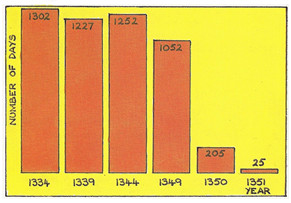
Days of
labour service, Cuxham in England
asked:
‘When Adam delved and Eve span, Who was then the
gentleman?... From the beginning all men by nature
were created alike, and our bondage or servitude
came in by the unjust oppression of naughty men… And
therefore I exhort you to consider that now the time
is come, appointed to us by God, in which ye may (if
ye will) cast off the yoke of bondage, and recover
liberty’.
None of the rebellions were successful. But in the
end the disintegration of the feudal system of
managing agriculture began with the freedom of the
peasants recognized.
It was not only landowners and workers who were
affected by the Black Death - the Church was also
hit. A higher percentage of priests were affected
then other members of the public. Why would God be
punishing so many churchmen? Parishes often lost
their priest and eventual replacements were often
less qualified. In Suffolk, in England, two-thirds
of the Church offices became vacant after 1349.
Communities that grew up around churches were
sometimes lost. The Black Death led to cynicism
toward religious officials who could not keep their
promises of curing plague victims. No one, the
Church included, was able to cure or accurately
explain the reasons for the plague outbreaks. Many
people were angry and bitter, and blamed the Church
– some historians think this helped the growth of
the new 'Lollard' religion in the 15th century and
ultimately, the Reformation. (see later)
In Eastern Europe, by contrast, strict laws tied the
remaining peasant population more tightly to the
land than ever before through serfdom. Sparsely
populated Eastern Europe was less affected by the
Black Death and so peasant revolts were less common
in the fourteenth and fifteenth centuries, not
occurring in the east until the sixteenth through
nineteenth centuries. Since it is believed to have
in part caused the social upheavals of 14th and 15th
century, some see the Black Death as a factor in the
Renaissance and even the Reformation in Western
Europe. The Black Death may be seen as partly
responsible for Eastern Europe's considerable lag in
scientific and philosophical advances, as well as in
the move to liberalize government by restricting the
power of the monarch and aristocracy. A common
example is that England is seen to have effectively
ended serfdom by 1550 while moving towards more
representative government; meanwhile, Russia did not
abolish serfdom until an autocratic tsar decreed so
in 1861.
Activity 3 - The
short and long-term consequences of the Black Death
Using the text in this
section and the above video, explain carefully how
the Black Death led to the decline of the feudal
system.