The excitement of perspective passed into art in north
Italy, in Florence and Venice, in the fifteenth century.
A manuscript of Alhazen's Optics in translation in the
Vatican Library in Rome is annotated by Lorenzo
Ghiberti, who made the famous bronze perspectives for
the doors of the Baptistry in Florence. He was not the
first pioneer of perspective - that may have been
Filippo Brunelleschi - and there were enough of them to
form an identifiable school of the Perspectivi. It was a
school of thought, for its aim was not simply to make
the figures lifelike, but to create the sense of their
movement in space.
The movement is evident as soon as we contrast a work by
the Perspectivi with an earlier one. Carpaccio's
painting of St Ursula leaving a vaguely Venetian port
was painted in 1495. The obvious effect is to give to
visual space a third dimension, just as the ear about
this time hears another depth and dimension in the new
harmonies in European music. But the ultimate effect is
not so much depth as movement. Like the new music, the
picture and its inhabitants are mobile. Above all, we
feel that the painter's eye is on the move.
Contrast a fresco of Florence painted
a hundred years earlier, about AD 1350. It is a view of
the city from outside the walls, and the painter looks
naively over the walls and the tops of the houses as if
they were arranged in tiers. But this is not a matter of
skill; it is a matter of intention. There is no attempt
at perspective because the painter thought of himself as
recording things, not as they look, but as they are: a
God's eye view, a map of eternal truth.
The perspective painter has a different intention. He
deliberately makes us step away from any absolute and
abstract view. Not so much a place as a moment is fixed
for us, and a fleeting moment: a point of view in time
more than in space. All this was achieved by exact and
mathematical means. The apparatus has been recorded with
care by the German artist, Albrecht Durer, who travelled
to Italy in 1506 to learn 'the secret art of
perspective'. Durer of course has himself fixed a moment
in time; and if we re-create his scene, we see the
artist choosing the dramatic moment. He could have
stopped early in his walk round the model. Or he could
have moved, and frozen the vision at a later moment. But
he chose to open his eye, like a camera shutter,
understandably at the strong moment, when he sees the
model full face. Perspective is not one point of view;
for the painter, it is an active and continuous
operation.
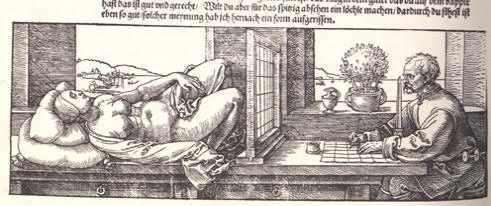
In early perspective it was customary to use a sight and
a grid to hold the instant of vision. The sighting
device comes from astronomy, and the squared paper on
which the picture was drawn is now the stand-by of
mathematics. All the natural details in which Durer
delights are expressions of the dynamic of time: the ox
and the ass, the blush of youth on the cheek of the
Virgin. The picture is The adoration of the Magi. The
three wise men from the east have found their star, and
what it announces is the birth of time.
The chalice at the centre of Durer's painting was a
test-piece in teaching perspective. For example, we have
Uccello's analysis of the way the chalice looks; we can
turn it on the computer as the perspective artist did.
His eye worked like a turntable to follow and explore
its shifting shape, the elongation of the circles into
ellipses, and to catch the moment of time as a trace in
space.


