This is the most
famous chair in Switzerland. It belonged to Jean
Calvin and in a few weeks you will get a chance to not
sit in it when we visit Geneva cathedral.
There are a few occasions when what happens in
Switzerland is of global importance. What Jean
Calvin does to Geneva from 1534 until his death
in 1564, is without doubt one of them. Calvin
changed the world; but he wasn't Swiss and in 1534,
neither was Geneva.
In the 100 years
after Luther, European society became
increasingly divided over the question of
religion. 1534 is a key date. In 1534 Paul III
became pope and Jean Calvin escaped persecution
in France by fleeing to Switzerland. What Pope
Paul III set in motion was a successful catholic
counter attack against the spread of
Protestantism. What Jean Calvin did was develop
a brand of Protestantism that was more
fundamentalist than Lutheranism, with
significant implications for the development of
the modern world.
How did
Catholicism survive? The Empire Strikes Back.
The Counter Reformation or the
Catholic Reformation, which dates from 1534, was the
Roman Catholic Church's reaction to the Protestant
Reformation. The
Protestant gains in Europe finally forced Pope Paul III
in 1545 to clarify the doctrine of the Catholic Church.
This council, called the Council of Trent, worked on
this problem in three separate sessions from 1545 to
1563. This council eventually advised some far-reaching
reforms in the abuses practiced by the church, such as
banning the selling of indulgences. The Council forced bishops
to live in the region they were responsible for and also
banned the selling of important positions of
responsibility in the Church. In addition, to reform, the
Council decided that seminaries (theological schools) should be built
throughout Europe so that church doctrine could be
spread easily and priests could be better educated.
Soft-power and coercion
In the late 1980s, political scientist
Joseph Nye developed a theory about the way countries
can be influential around the world without using force.
What he called 'soft power' are the diplomatic means by
which states can obtain favourable outcomes through the
spread of ideas and values. The Catholic Counter
Reformation was also a form of soft power. The Catholic Church encouraged
the foundation of new groups or ‘orders’ that supported
a disciplined return to the essential ideas of
Christianity. Led by intellectuals and concerned with
education, the most important of the movements was the
Society of Jesus or the Jesuits, founded by Ignatius of
Loyola. At the start the Jesuit movement was a small
movement. The original Society of Jesus had only ten
members. By 1630, it had over fifteen thousand members
all over the world.
As well a willingness to work enthusiastically and
tirelessly in hostile countries, the Jesuits also shared
an absolute loyalty to the pope. As Ignatius of Loyola
famously said "I will believe that the white that I
see is black if the hierarchical Church so defines it."
They have been described by some historians as the
'storm troopers' of the counter reformation and they
certainly established a missionary tradition that
rediscovered an active proselytizing role for the Catholic Church,
particularly in European colonies abroad.
In 1622 a new administrative body of
the Catholic church was created called the
Congregatio de Propaganda Fide (Congregation for
Propagating the Faith). Its activity was aimed at
"propagating" the Catholic faith in non-Catholic
countries. This is where our modern use of the word
propaganda originates.
Joseph
Nye's concept of soft-power,
Soft power is the ability to
attract and co-opt, rather than by coercion
(hard power), which is using force or giving
money as a means of persuasion. Soft power
is the ability to shape the preferences of
others. A
defining feature of soft power is that it is non-coercive; the currency of soft power is
culture, political values, and foreign
policies.
As well
as using soft-power, the Catholic Church also continued
to rely on the coercive methods of the inquisition that
we encountered in the late medieval period. With the
rise of Spain as a dominant European power in the 16th
century, the defence of Catholic interests became
closely associated with the interests of Spain and the
Holy Roman Empire. The Tribunal of the Holy Office
of the Inquisition, commonly known as the Spanish
Inquisition, was established in 1478 by Catholic
Monarchs Ferdinand II of Aragon and Isabella I of
Castile. It was intended to maintain Catholic orthodoxy
in their kingdoms, which included the Canary
Islands, the Spanish Netherlands, the Kingdom of Naples,
and all Spanish possessions in North, Central, and South
America.
According to modern estimates, around 150,000
were prosecuted for various offenses during the three
centuries of the Spanish Inquisition, out of
which between 3,000 and 5,000 were executed. The first
trials against Lutheran groups, took place
between 1558 and 1562, at the beginning of the reign of
Philip II, against two communities of 120 Protestants from
the cities of Valladolid and Seville. The trials signaled a notable intensification of
the Inquisition's activities. A number of autos-da-fé
(see below)
were held, some of them presided over by members of the
royal family, and around 100 executions took place.
Spanish Inquisition also worked actively to stop the
diffusion of heretical ideas in Spain by producing
"Indexes" of prohibited books.
Monty Python on the Spanish Inquisition
The Spanish Inquisition
Tribunal
The
Monty Python sketch above and numerous
Hollywood films have helped create a certain
impression of the Spanish Inquisition. In
Protestant countries, stories about the
horrors of the inquisition have also been
exaggerated. However, the following is an
accurate description of what would happen
when the inquisition came to town...
On the next Sunday after mass
the congregation was encouraged to confess
their heresies without facing fear of severe
punishment. They were also encouraged to
denounce others. Denunciations were
anonymous and might be made for a number of
reasons. If denounced, the accused
faced imprisonment until trial. This could
last months or even years and the accused's
family was expected to pay for the cost of
imprisonment. Nobody was given any
information about the charges faced.
The trial heard the
evidence of the accusations and torture was
used to produce a confession. The accused
had no lawyer to defend them. Torture was
always a means to obtain the confession of
the accused, not a punishment itself.
Torture was also applied without distinction
of sex or age and was used with children and the
elderly.
The methods of torture
most used were garrucha, toca and the
potro.
The application of the garrucha, consisted
of suspending the victim from the ceiling by
the wrists, which are tied behind the back.
Sometimes weights were tied to the ankles,
with a series of lifts and drops, during
which the arms and legs suffered violent
pulls and were sometimes dislocated. The
toca consisted of introducing a cloth into
the mouth of the victim, and forcing them to
ingest water spilled from a jar so that they
had the impression of drowning. [Today this
is called 'waterboarding' as used by the
CIA] The potro, the rack, in which the limbs
were slowly pulled apart, was the instrument
of torture used most frequently.
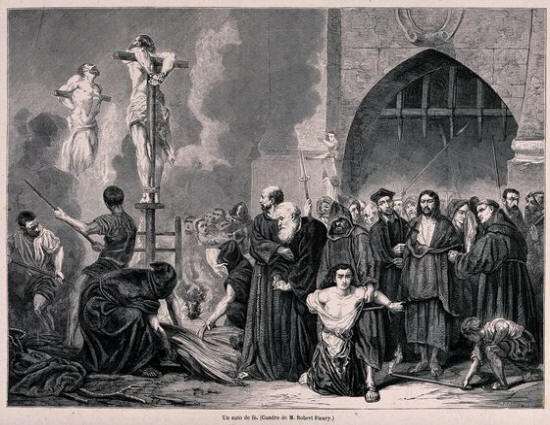
The most famous, but not
most common punishment, was the auto-da-fé.
The auto-da-fé involved a Catholic Mass,
prayer, a public procession of those found
guilty, and a reading of their
sentences. They took place in public squares and lasted several hours
and all local authorities
attended. It was followed by the punishment,
the most severe of which was burning at the
stake. It is important to note that
punishment happened when auto-da-fé had
finished.
1. What evidence is there that the Catholic Church
eventually accepted some of the criticisms of Martin Luther?
2. Why might the Jesuits be considered a
good example of Nye's soft power?
3. Read carefully the process followed by
the Spanish Inquisition Tribunal. Compare it to the
United Nations
Universal Declaration of Human Rights. Which
Articles did the Inquisition Tribunal break?
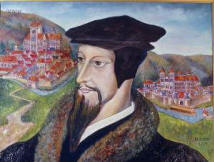
Jean
Calvin and Geneva.
Jean
Calvin was a French Protestant who fled from religious
persecution to Switzerland in 1534. Calvin strongly
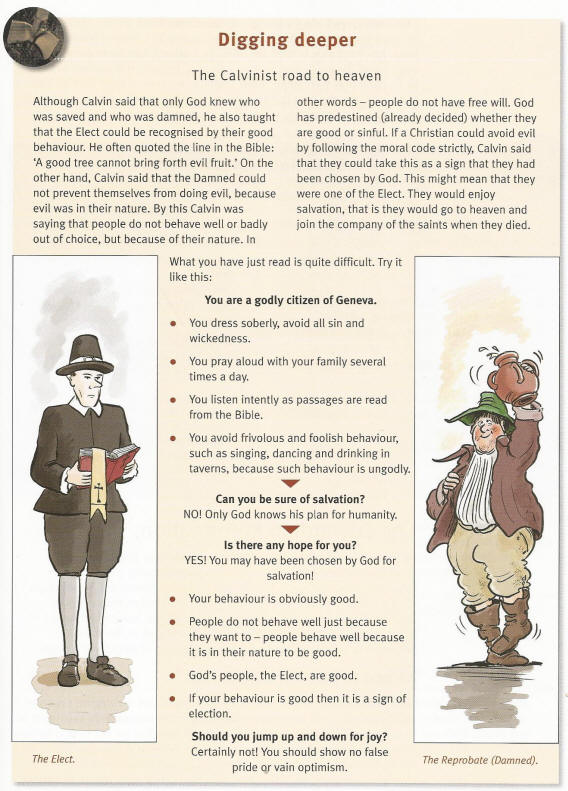
believed in predestination. This is the idea that God
has already decided whether people would go to heaven or
hell before they were even born. Men and women were thus
divided into two groups: the Elect and the Reprobate.
The Elect were chosen by God for eternal life in heaven,
while the Reprobate were damned and would go to hell.
The
Ranters
I have always struggled to
understand why this idea of predestination
took off. Surely, if it didn't matter what
anyone did - because God had already decided
-
why bother following a strict religious
code? In fact, in England during the
mid-17th century there was a religious group
called the 'Ranters' who did believe this.
They were famed for their drinking, nudity,
swearing and sexual promiscuity.
Some historians question
whether they really existed, or whether they
were made up by conservatives as an early
example of 'fake news'.
The most important thing about Calvinism, is that it
provided Christianity with a different relationship with
money and work. For medieval Catholics, money was best
invested in the church. You could buy yourself salvation
by paying for monks to say prayers or though
indulgences. For Calvinists it was all very different.
They were obsessed with looking for evidence that they
were amongst the elect. Having money was considered
reliable evidence that
God had chosen you.
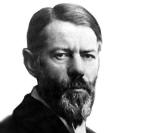
The sociologist Max Weber has been
very influential in helping to explain the importance of
this money making incentive of Calvinism to the making of the modern world. Unlike
Marx, who explained the development of the capitalist
modern world as being the result of structural, material
change, (see previous lessons) Weber emphasized the
importance of ideas. And one idea was particularly
important, 'The Protestant Work Ethic'.
The
harder they worked at something, the more they were likely to be
successful and become rich. As financial success was evidence that God had chosen
you, hard work acquired an intrinsic value. Calvinists were
obsessed with time being used productively, people should
show a 'busy-ness' in their lives and not waste time in
idle 'pass-times'.
Calvin made up a strict moral code for
all citizens of Geneva; a code that was designed to keep
people focused on the important things in life.
Only plain clothes were permitted; jewellery and make-up
could not be worn. Men and women had to cut their hair
short. Sex outside marriage was strictly forbidden.
Music and games were discouraged. Drunkenness and
gambling were punished. Theatres were closed down.
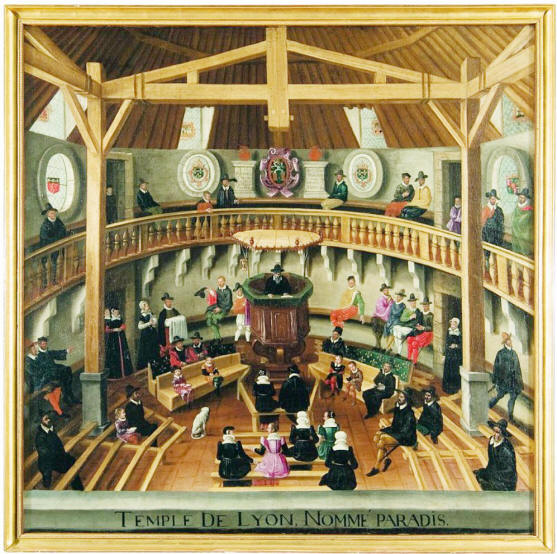
Church buildings were to be very simple. This
pursuit of an austere, strict moral life became
associated with Puritanism.
Consider this contemporary image of a
Calvinist church in France, in what ways is it different
from Catholic churches from the same period?
As with the Jesuits, one of Calvin's
greatest successes was through the soft-power of
education. A theological college was established in
Geneva which welcomed students from abroad. Those
students then went on out into the world as missionaries to
spread the word. Calvin's publications, most notably,
Institutes of the Christian Religion spread his ideas to many
parts of Europe especially Scotland, the Netherlands,
and parts of Germany but he was also influential in
France, Hungary, Transylvania, and Poland. Most settlers
in the American Mid-Atlantic and New England were
Calvinists, including the Puritans and Dutch settlers of
New Amsterdam (New York). More on that in a future
lesson. See our visit to the
Reformation Museum in Geneva for more.
Weber -
The Protestant Work Ethic.
The Protestant work ethic, is
a concept in theology, sociology, economics
and history which emphasizes that hard work,
discipline and frugality are a result of a
person's subscription to the values espoused
by the Protestant faith, particularly
Calvinism.
The concept is often credited with helping
to define the societies of Northern, Central
and Western Europe such as in Scandinavia,
the Netherlands, the United Kingdom,
Germany, and Switzerland. The phrase was
initially coined in 1904–1905 by Max Weber
in his book The Protestant Ethic and the
Spirit of Capitalism
Activity 2
Read the text and watch the film on
Calvin above.
1. Explain what is meant by
'predestination'.
2. Explain how Calvinism encouraged the
early development of capitalist business.