We started the year looking at medieval
feudalism and power. The medieval feudal state depended
on coercion and persuasion, (force and church) it
did not depend on the consent of the governed. People
did not have a say in who ruled over them or how they
were ruled. The
church played a very important role in this. We can
identify three important features of this.
1) The views of the individual did not
matter, most individuals were peasants who could neither read
nor write. The church controlled what it was possible
for individuals to believe, therefore belief was not
individual but communal.
2) It was not an egalitarian society with individual
rights, but rather an inegalitarian society in which
people had duties to the community depending on the
feudal 'station' they were born in to. If you are born a
serf, you do labour service to the lord of the manor.
3) God ordained this social hierarchy; kings and nobles
ruled because they enjoyed a divine right to do so.
Rebellion could never be justified. The job of the
individual is to care for his soul to guarantee a
heavenly afterlife.
What Luther does is undermine all this with how he
interprets the Bible. In particular, Paul’s letter to
the Romans. Romans 1:17 'For therein is the
righteousness of God is revealed from faith, to faith:
as it is written: 'The just shall live by faith.'
All you need is faith. Solo fide.
By rejecting the orthodoxy, (the right of the church
alone to interpret the word of God) Luther undermines
the three features of Catholicism which helped keep
medieval society stable,
1) The individual and their conscience do matter.
Luther's belief in Solo Fide meant that everyone
should have a chance to communicate directly with God.
Translating the Bible into the vernacular (English,
German, French etc.) would enable all to have direct
access to His word. Here in Luther we see the importance
of individualism in the Humanist tradition.
2) As in feudalism, the Catholic church gave special roles to priests,
bishops and the whole hierarchy of the church, as
intermediaries between God and the congregation. They
spoke Latin, wore fancy clothes, big hats and sat apart. Luther
was egalitarian. He spoke about a 'priesthood of all
believers', everybody had a direct line to God.
3) Luther taught that God does not provide authority to
the actions of kings. In Luther's 'two kingdoms' theory, there is a
kingdom of God and and kingdom of princes. On earth, it
is kings that have authority. This idea would prove to be a
popular with German princes in their arguments with
Italian popes.
But undermining the divine role in providing authority
also encouraged more radical ideas about who should have
authority.
Political revolution.
Luther's religious reform quickly mutated
into a political revolution. Once the authority of the
church was questioned, then all authority was up for
debate. If you allow all to read and interpret the Bible
for themselves, some will read into the Bible that the
religious equality should also be a social equality. And
when these inflammatory ideas could be spread
easily through with the printed word then revolutionary
violence was quick to follow. This is true of all
revolutions. Revolutions undermine established
authority, but once you allow some criticisms of
authority it is very difficult to stop. Luther unleashed
a wave of ideas over which he had no control.
Luther was happy enough to see his ideas used by German
rulers to assert their independence from Rome, less that
happy when peasants used his ideas to assert their
independence from their feudal lords. This is exactly
what happened with Thomas Müntzer. Müntzer had been a
follower of Luther but broke with Luther in support of
the peasants. 1524 German peasants demanded social
equality in the most significant European revolution
before the French Revolution of 1789. 100,000 were
killed. As Tristam Hunt argues in the following
film: ‘Once people felt justified to think for
themselves no power could remain unchallenged’
Activity 1
From the text and video (and not through a Google
search) explain the meaning and importance of the
following Lutheran concepts:
(i) Sola Fide
(ii) Priesthood of all believers
(iii) Two kingdoms theory
Explain the importance of the printing press to Luther’s
ideas
‘Once people felt justified to think for themselves no
power could remain unchallenged’ How did Luther’s ideas
lead to Muntzer’s rebellion?
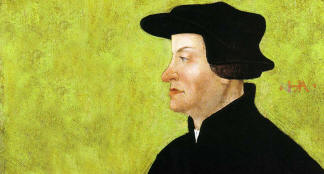
Huldrych Zwingli - Don't call him the
Swiss Luther!
Huldrych Zwingli was born in 1484, in
Wildhaus, in the Toggenburg valley of Switzerland, just
a few months after Martin Luther. Educated in Humanist
dominated University of Basel, he came to very similar
conclusions about the Catholic Church as Luther, but did
so independently. Historians disagree about
the extent of his independence. Also, like Luther, he
joined the church, learnt Greek and went to Rome. He
read Erasmus’s translation of the Bible and was enraged
by an indulgence salesmen. But, he didn’t like being
called a Lutheran ‘I will not have the papists call me a
Lutheran, for I did not learn Christ’s teaching from
Luther, but from the word of God’.
Affair of the sausages.
Zwingli noted that nowhere in the Bible are there rules
about food and fasting. During Lent in 1522 Zwingli led
a small group of devotees to eat sausage and eggs, and
to therefore break with the church convention of the 40
days of fasting (not eating meat, milk, cheese etc.) in
the run up to Easter (Lent).
Next Zwingli challenged the church on the
issue of the celibacy of priests and the use of images
in church. In 1523, Zwingli outlined his arguments in
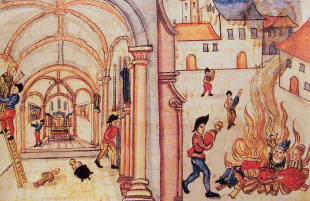
the 67 Articles. In Zurich in 1524 (see right), the
council instructed churches to remove all religious
images so that people would be encouraged to pray to
directly to God, not via objects that could be seen and
touched (iconoclasm). This whitewashing of churches
became a notable practical consequence of the
Reformation.
But he didn’t completely agree with Luther about
everything. At Marburg castle in 1529 Luther and Zwingli
famously failed to agree on the significance of the
Eucharist and transubstantiation. Zwingli argued that
the blood and wine were mere symbols, but Luther still
clung to the Catholic belief that Jesus was actually
present. This may seem a very 'academic'
disagreement, but it would lead to a lot of bloodshed.
For example, 20 years
later in England, thousands of people were killed
because they demanded the right to have a Catholic mass
which still transformed the bread and wine into the body
and blood of Jesus.
This was typical of one of the key consequences of the
Reformation. Once the Bible was opened up to
interpretation, interpretation was always going to lead
to disagreement. The violence that accompanied the
Reformation was not always between Catholics and
Protestants, but often between different branches of
Protestantism. (See Muntzer above)
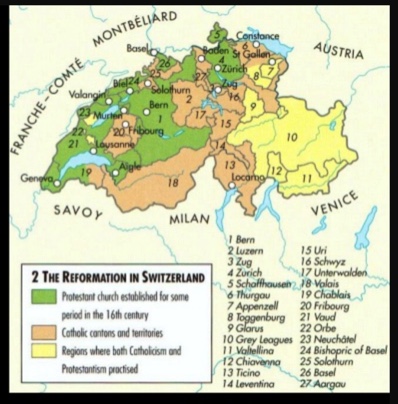
Zwingli’s ideas began to spread throughout Switzerland
but they also faced serious opposition. The Swiss
Confederation in Huldrych Zwingli's time consisted of
thirteen states (cantons) as well as affiliated areas
and common lordships. Unlike the modern state of
Switzerland, which operates under a federal government,
each of the thirteen cantons was nearly independent,
conducting its own domestic and foreign affairs. Each
canton formed its own alliances within and without the
Confederation.
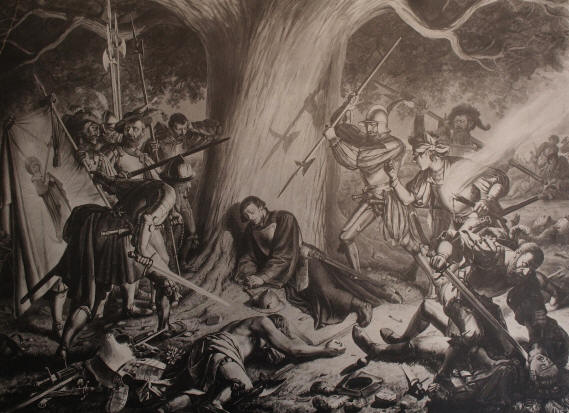
In 1531, the Catholic states of the Swiss Confederation
declared war on Zurich and in battle Zwingli was
seriously injured before being finished off by Captain
Fuckinger of Unterwalden.
Activity 2
Compare and contrast the life and ideas of Huldrych
Zwingli with those of Martin Luther.
Henry VIII and the English
Reformation
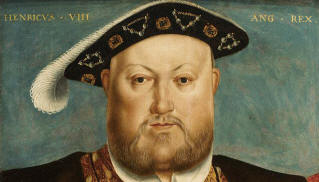
In England King Henry VIII was horrified by
Luther's attack on the Church and wrote a book attacking
the German monk. However, Luther's ideas spread quickly
to England, where the man responsible for defending the
country against heresy was Cardinal Thomas Wolsey. In
1521, soon after the Diet of Worms, Wolsey organised a
public bonfire outside St Paul's Cathedral to burn
Lutheran books confiscated in England. The bishops were
ordered to track down anyone who was spreading Luther's
ideas, either by preaching or in print. Against this background of corruption in
the Church in England, Luther's ideas began to gain
ground. In Wittenberg in 1525, Englishman William
Tyndale, an associate of Martin Luther, had translated
the New Testament into English with a commentary to show
how much the Roman Catholic Church had moved away from
the true Word of God.
;
The King's Great Matter
To understand why the English Reformation occurred, we
must focus on Henry VIII himself and the problems of
his marriage with Catherine of Aragon. Catherine was the
daughter of the King and Queen of Spain. Catherine's
nephew, Charles, became Charles V, the Holy Roman
Emperor and King of Spain in 1519. He banned Luther at
the Diet of Worms.
Henry married Catherine when he became king in 1509, at
the age of eighteen, and to begin with they were very
happy together. However, they seemed to have no luck
producing children.
After many years of trying for a son with Catherine,
Henry began to doubt whether their marriage was proper
in the eyes of God. Catherine had actually been married
before, to Henry's older brother, Arthur, when she and
Arthur were both fifteen. However, Arthur had died after
only four months of married life. To preserve the
friendship between England and Spain, Catherine had been
quickly betrothed to the young Henry. Now Henry was
starting to believe that this marriage was forbidden by
the Bible. In the Book of Leviticus it was written, 'If
a man shall take his brother's wife it is an unclean
thing. They shall be childless'. In addition, he had
fallen in love with one of Catherine's maids of honour,
Anne Boleyn.
In Henry's time, divorce, as we know it
today, was forbidden by the Church. Only God could end a
marriage - by death. However marriages could be annulled
- the Church could declare that the man and woman had
never been properly married.
Henry VIII now ordered Cardinal Wolsey to persuade the
Pope to annul his marriage to Catherine of Aragon, on
the grounds that it was against the law of God. Henry's
main problem was that in 1527 the pope was actually the
prisoner of Catherine's nephew, the Emperor Charles V.
In 1529 - Pope Clement VII refused to grant a divorce.
Henry VIII now began to listen to some of the
anti-clericals who were saying that the Church had too
much power. Anne Boleyn lent him a copy of a book by
William Tyndale ‘The obedience of a Christian
Man’. who followed Luther in arguing that the
king, not the Pope, was really the head of the English
Church. 'The king is in the room of God and his law is
God’s law’. In response to which, Henry is said to have
commented ‘This is a book for me and all Kings to read’
In addition, Henry was aware that In Germany, Lutheran princes had closed down
the monasteries and confiscated their property.
Matters became urgent late in 1532, when Anne at last
gave in to Henry and began to sleep with him. She soon
became pregnant. Henry was anxious to make sure that the
child was legitimate and could succeed to the throne, so
he married Anne in secret, in February 1533. Two months
later Archbishop Cranmer held a court, which declared
that the marriage of Henry and Catherine had been
unlawful in the sight of God, so should be regarded as
never having happened.
Catherine of Aragon was now
informed that she had never been Henry's wife, but had
merely been living with him in a sinful relationship,
and her daughter Mary was declared a bastard. She also
had to endure Anne, six months pregnant, being crowned
Queen of England, in June 1533.
When the baby was born it must have been a
disappointment for Henry - it was a girl, Elizabeth.
Parliament agreed to
change the laws of England, declaring an end to the
authority of the Pope over England's Church. In the
future, the king would be the Supreme Head of the Church
of England. The clergy would pay taxes to him, and all
people had to accept that Henry had the right to marry
Anne Boleyn. By the Act of Succession of 1534 nobles,
monks and priests had to swear an oath that they agreed
to this - to deny the right of Anne to be queen or of
her heirs to inherit the throne was now treason,
punishable by death.
Activity 3
Read the text above and watch the video.
How important were Lutheran ideas to the English
Reformation? This is a debatable question, so your
answer must be both yes and no, with evidence to support
both sides.