Unit 4 - Lesson 1 -
The philosophers of the Enlightenment
What
was the Enlightenment? - Part 2 The Philosophers
The Enlightenment was an intellectual and cultural
movement of the seventeenth and eighteenth centuries. It
emphasised reason, logic, criticism and freedom of
thought over faith and superstition. One of the most
important features of the Enlightenment was the
Scientific Revolution.
What
is political philosophy?
Political philosophy can be defined as
philosophical reflection on how best to arrange our
collective life through our political institutions:
laws, monarchy, parliament etc. Political philosophers
seek to establish basic principles that will, for
example, justify a particular form of state, show that
individuals have certain rights, or tell us how a
society's wealth should be shared among its members.
Some political philosophers have tried to justify
current political institutions (conservatives); others
have painted pictures of an ideal state that is very
different from anything we have so far experienced
(radicals).
Who were the main Enlightenment thinkers?
– The Philosophers
Thomas Hobbes
(1588-1679) was an English philosopher. In
his book Leviathan (1651) – by the way a
Leviathan is a sea monster - Hobbes is famous
for saying that man’s life without strong
government would be naturally “solitary, poor,
nasty, brutish and short.” Hobbes saw man as
naturally selfish and immoral. Because of fear
of death the individual will give away his
rights to a king. The important point is that
kings grew powerful not by divine right (the
medieval concept) but by force.
A king’s power
came not from above but from below, from his
subjects. Since the king got his power from the
people, the people had the right to overthrow
him.
;
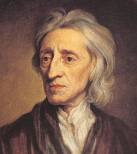
John Locke
(1632-1704) was an English philosopher who
thought that the human mind at birth was a
tabula rasa (blank tablet) that we are born
without innate ideas, and that knowledge comes
from experience derived from sense perception.
His most important political book was Two
Treatises on Government (1689). Locke argues men
are born free and equal in rights. Government
derives its authority from the agreement of the
governed to be governed through a ‘social
contract’.
Powers of
government are limited and maybe removed if
poorly exercised. John Locke is considered to be
the father of modern liberalism and was
influential on the American revolutionaries.
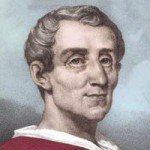
Montesquieu
(1689- 1755) Charles-Louis de Secondat, a
French philosopher, his most influential work
L'esprit des lois (1748) argued for the
separation of powers in government. That a
government’s powers should be divided between
the legislature (law maker), the executive (law
enforcer), and the judiciary (law interpreter).
These should be separate from and dependent upon
each other so that the influence of any one
power would not be able to exceed that of the
other two.
This was radical
because it completely ignored the three Estates
structure of the French Monarchy: the clergy,
the aristocracy, and the common people, the
essence of feudalism.
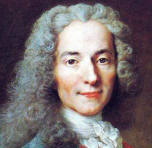
Voltaire
(1694 –1778) François-Marie Arouet, a French
writer and philosopher, Voltaire is remembered
as a courageous polemicist who fought for
toleration, civil rights – the right to a
fair trial and freedom of religion – and who
denounced the hypocrisies and injustices of the
ancien régime. The ancien régime
involved an unfair balance of power and taxes
between the First Estate (the clergy), the
Second Estate (the nobles), and the Third Estate
(the commoners and middle class, who were
burdened with most of the taxes).
His famous
defence of the right to free speech is often
quoted: ‘I may not agree with what you say, but
I will defend to the death your right to say
it’.
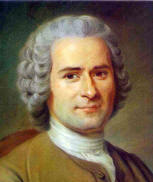
Jean-Jacques
Rousseau (1712 –1778) a Genevan philosopher,
writer, and composer. The complete opposite
of Hobbes, Rousseau argued that man is naturally
good but is corrupted by bad society ‘Man was/is
born free; and everywhere he is in chains’
Social Contract (1762). Good government for
Rousseau will be that which is of the greatest
benefit to society as a whole. Rather than have
a government which protects the wealth and the
rights of the powerful few, government should be
fundamentally based on the rights and equality
of everyone, the ‘General Will’.
If any form
of government does not look after the rights,
liberty, and equality of everyone,
then that government should be overthrown.
Diderot (1713
– 1784) and D'Alembert (1717 – 1783)
– Les Encyclopédistes. The Encyclopedia
(between 1751 and 1772) was in fact the
collective effort of over one hundred French
thinkers. The central purpose of the work was to
take learning away from the influence of the
Church. For the Encyclopédistes human
improvement was not a religious issue, but
simply a matter of mastering the natural world
through science and technology and mastering
human behaviour through an understanding of how
individuals and societies work.
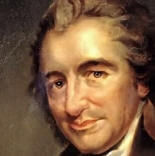
Thomas Paine
(1737-1809) was an author, pamphleteer,
radical, inventor, intellectual, revolutionary,
and one of the Founding Fathers of the United
States. Born in England, Paine emigrated to the
British American colonies in 1774 in time to
participate in the American Revolution. His
principal contribution was thr pamphlet Common
Sense (1776), arguing for colonial America's
independence from Great Britain. He also wrote
the Rights of Man (1791) in which he argued for
political rights for all men because of their
natural equality and against all forms of
hereditary government.
Only a
democratic republic could be trusted to
protect the equal political rights of all men.
Activities
1. What is political philosophy? Explain the difference
between conservative and radical political philosophers.
2. Check your understanding of the text by defining the
meaning of the all 10 words/phrases in bold.
3. Now learn 'who is who' of all the Enlightenment
thinkers - scientists and philosophers - by playing this
fling the teacher quiz. Expect to be 'tested' on it next
lesson.


.jpg)