The
execution of Louis XVI shocked millions of people all
over Europe. Louis' fellow monarchs were outraged. One
by one, in the first months of 1793, they joined forces
with Austria and Prussia in their war against France.
The aim of this coalition, or alliance, was to destroy
the new French Republic.
Far from scaring the revolutionaries in France, this
made them more warlike than before. They wanted to fight
these 'tyrants', as they called all kings, and spread
the revolution to the rest of Europe. Rather than wait
for the coalition to attack them, they declared war on
its three latest members - Britain, Holland and Spain.
France was now at war with most of Europe.
Disaster immediately struck the French armies. Austrian
forces beat them in a series of battles in the
Netherlands. The French commander, General Dumouriez,
abandoned his men and went over to the Austrian side.
France seemed on the verge of defeat.
Inflation and shortages
The war was only one of many difficulties facing the new
government. A major problem was the high price of food.
Prices were rising because, to pay for the war. the
government was printing huge amounts of paper money
called assignants . But the more bank notes it printed,
the less they were worth: the currency was suffering
from inflation. By February 1793 a bank note was worth
only half the amount printed on it.
As well as being expensive, bread was also scarce
because farmers did not want to sell their grain for
bank notes that were losing their value. Hungry sans
culottes began raiding shops and food stores to get the
food they could not buy.
Rebellion
A third major problem hit the government when, to defend
the country, it ordered an extra 300,000 men to join the
armies. This order was deeply unpopular. In the Vendee
in western France, where many people were royalists,
thousands of peasants joined in an armed rebellion
against the government.
In Paris, the war led to a conflict between two groups
of politicians in the Convention: the Girondins, who
held most of the important posts in the government, and
the Jacobins, who were supported by the sans culottes.
The Jacobins blamed the Girondins for France' s defeats
on the battlefield, and for allowing food prices to
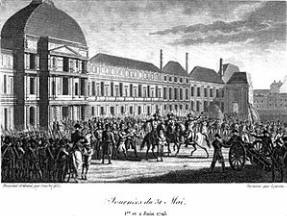
rise. On 2 June an angry crowd of sans culottes broke
into the Convention and expelled the leading Girondins.
This triggered off a string of revolts in the provinces
which supported the Girondins. By summer 1793, sixty out
of eighty-three departments had joined the rebellion
against the government.
The Reign of Terror
Faced with all these disasters, the
Convention set up an emergency group called the
Committee of Public Safety. Its twelve members had the
power to do anything they thought necessary to save
France. From July 1793 and for the next twelve
months, they used this power to run France very strictly
and to impose harsh punishments on opponents. So harsh
was the Committee's rule that it was known as the 'Reign
of Terror'.
The Death of Marat
Jean-Paul Marat was born in Boudry in
Neuchatel, now part of Switzerland. Typically, his
family was French Huguenot in origin and for most of his
20s he lived in England and practiced as a doctor. From
the outbreak of the revolution he dedicated himself
entirely to spreading the ideas of the radical wing of
the revolution, that after 1792
became known as Jacobin. His newspaper L'Ami du
peuple was highly critical of post revolutionary
authorities and until the death of the king, Marat was
often forced into hiding or exile. His time spent hiding
in the Parisian sewers worsened his already debilitating
skin disease. After the beheading of the King, Marat
turned his newspaper on the Girondins and it was
this attack that led to his assassination by Charlotte
Corday.
Marat was in his bath (because of his
skin condition) on 13 July 1793, when Corday appeared at
his flat. She gave him a list of supposed Girondin
traitors and he promised to have them all guillotined.
She then stabbed him through the heart with a kkitchen
knife that she had hidden in her dress. His death was
immediately turned into a political martyrdom by the
Jacobin Committee of Public Safety. David's idealized
painting, that depicts Marat in Christ like form, was
part of a process that turned Marat into a secular
saint. After the revolution, Marat's reputation fell;
the memorials to him were destroyed and his remains were
removed from the
Panthéon.
However, over 100 years later, after the October
revolution 1917 in Russia, Marat's name was
rehabilitated by the Bolshevik
government. Marat became a popular name for Russian
babies and Russian streets and Battleships were also
named after him.
With reference to the origin, purpose and content of the
painting, examine the strengths and weaknesses of
David's Death of Marat as evidence about
divisions in France during the Reign of Terror.
The Law of Suspects
The Terror began with a 'Law of Suspects' in September
1793. As a precursor to the encouragement of
denunciations common in 20th century authoritarian
states such as Stalin's Russia and Hitler's Germany. Groups of citizens in every town had to draw up
lists of people they suspected of opposing the
government. Almost anyone could fall under suspicion.
The Law said that suspects were people who by their behaviour, their contacts, their words or their
writings, showed themselves to be ... enemies of
Liberty.' In the year that followed, over a quarter of a
million suspects were arrested and put in prison. Many
suspects were sent to Paris for trial by the
Revolutionary Tribunal. This was a special court set up
to deal with political offences. Its judges could impose
sentences of imprisonment, deportation or death. Around
half the sentences they passed were death sentences.
The guillotine
Death sentences were carried out by beheading prisoners
with a recently invented machine. Known as a guillotine
after the person who first suggested using it, Doctor
Guillotin, it was meant to be quicker and less painful
than the methods of execution used before the
Revolution. An English journalist described how it
worked:
He [the prisoner] is first tied to a plank of wood of
about eighteen inches [45cm] broad, and an inch [2.5cm]
thick, with cords about the arms, body and legs; this
plank is about four feet [1.2m] long, and comes almost
up to the chin; the executioner then lays him on his
belly on the bench, lifts up the upper part of the board
which receives his neck, inserts his head, then shuts
the board and pulls the string fastened to a peg at the
top of the machine, which lifts up a catch. The axe
falls down, and the head, which is off in an instant, is
received in a basket ready for
I that purpose, as is the body in another basket.
From an anonymous broadsheet, Massacre of the French
King, 1793
Around 17,000 suspects were executed by guillotine
during the Terror. One of the first to die was Marie
Antoinette, executed in October 1793 for treason.
Terror in the provinces
The Committee of Public Safety took very strong measures
to crush the revolts in the countryside. Over a hundred
Representatives of the Convention were sent to the
provinces with instructions to do anything necessary to
restore order. In the Vendee, where the biggest revolt
was taking place, the Representative on Mission was
Jean-Baptiste Carrier. When the guillotine proved too
slow to execute captured rebels, he had them drowned in
boat-loads in the River Loire. At least 2,000 died in
these drownings at Nantes. In Lyons, nearly 2,000 rebels
were executed. To speed up the executions, prisoners
were lined up in front of open graves and blasted into
them with cannon fire.
Terror in the armies
In August 1793 the Convention ordered a 'Mass Levy' of
the French people. This meant that every citizen had to
take an active part in the war effort. Unmarried men had
to join the armies to fight. Married men were to make
weapons for them. Women were to make tents and serve in
hospitals. Children were to make bandages and gunpowder.
The Mass Levy increased the French armies to 800,000
men, nearly three times the size of the Coalition's
armies. Representatives of the Convention made sure that
strict discipline was kept. Generals who did not win
battles were replaced by younger officers who had proved
their ability in action.
Economic Terror
The Committee tried to halt the rise in food prices with
a Law of the Maximum in September 1793. This said that
the prices of forty goods, such as corn, flour, firewood
and oil, must stay fixed until further notice. So too
must people's wages. Breaking the Maximum carried the
death penalty.
Terror and the Church
The Terror led to the disappearance of the Christian
religion in many parts of France. Claiming that
Christianity was no more than 'superstition', sans
culottes closed down churches, robbed them of their
bells and silver, and sacked their priests. In many
towns, a 'Cult of Reason', based on revolutionary ideas
such as Liberty, took the place of Christianity.
As part of the campaign against Christianity, the
Convention introduced a new calendar. Years were no
longer counted from the birth of Christ but from
September 1792, when the Republic was founded. 1792—3
was re-named Year One, so the Terror took place in Year
Two. Each year was divided into twelve thirty-day months
with names describing their weather or growing seasons.
Months were divided into three ten-day weeks. Sunday was
abolished.
Results of the Terror
The Committee of Public Safety achieved what it set out
to do. It saved France from collapse. By mid 1794 the
French armies had driven their enemies right out of
France and had occupied the Austrian Netherlands. The
Representatives on Mission had crushed all the revolts
in the Provinces. And although prices were still rising,
the Committee had managed to avoid a famine.
The price of success had been high. Between 35,000 and
40,000 people had been executed or had died in filthy,
overcrowded prisons. Everybody's rights and freedoms had
been severely limited. Prices were still rising. And the
Committee had became a kind of twelve-man dictatorship.
The coup of Thermidor
By the summer of 1794 the Committee was very unpopular.
Many deputies in the Convention disliked it because they
thought it was too powerful. Some disliked it because
they feared ending up under the guillotine. Others
disliked it because they could not see any need for the
Terror now that the revolts were over and France was
winning the war. Even the sans culottes, its strongest
supporters, were unhappy because their wages were held
down by the Maximum law, while prices were still rising.
On 27 July 1794-9 Thermidor, Year Two in the new
calendar - the Convention decided to get rid of the
Committee's leading member, Robespierre, along with his
supporters. Twenty-one were arrested and guillotined the
following day. A further ninety-six were executed the
day after.
With Robespierre dead, the Convention reduced the power
of the Committee, freed hundreds of suspects, abolished
the Maximum and got rid of the Revolutionary Tribunal.
The Terror thus came to an end.
Click to enlarge
See this short article that
explains French attempts to
de-Christianise the calendar. And click
here to find out your birthday according to
the revolutionary calendar.