International
School History - International Baccalaureate - MYP History
MYP5
Last
update -
07 May 2018
Unit 11 - Civil
Rights - Feminism
Women
in 1950s Europe
In the early 1950s women made
up about one third of the western European workforce. Unlike in
the communist east, most of the jobs women did were low skilled
and low paid. The countries that hadn’t already given women the
right to vote, did so - France (1944), Belgium (1948) Italy
(1946) and Greece (1942) – but women’s participation in politics
remained low and much lower than in the East. When French
President Charles de Gaulle when asked about the possibility of
creating a Minister for Women’s affairs, replied ‘A Ministry?
Why not an Under-Secretaryship for Knitting?’ Some countries
even went backwards. Spain had extended the franchise to women
in 1931 but Franco’s regime (1939-75) subjected women to the
authority of the father or husband and effectively took away
their political rights.
Throughout western Europe in
the 1950s, the traditional women’s role was domestic. Legal
barriers existed everywhere. They were denied the right of equal
pay for doing the same work as men and in law the man was
considered the ‘head of the household’. In France for example,
before 1964 Women had to have her husband’s permission to get a
passport or open a bank account. And all the while, the domestic
ideal was reinforced in popular glossy magazines that encouraged
a feminine ideal of beautiful wives and caring mothers. Women in
the communist countries of central and eastern Europe enjoyed
greater equality with men, but they lacked the freedom that
living in a democracy brings.
Activity 1
Read the text above and watch
the films. Explain with examples how women faced discrimination
and did not enjoy the same civil rights as men.
The Women’s Movement
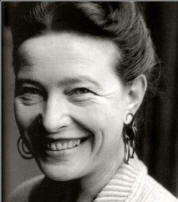
In 1949 French academic and activist Simone de Beauvoir (right)
published The Second Sex. The book was well received by her
fellow intellectuals but did not gain any widespread appeal
until the revival of feminism in the 1960s. In the book de
Beauvoir gives a detailed history of women's oppression and
exposes the inequalities society imposes on women. In 1963 an
American feminist, Betty Friedan, wrote The Feminine Mystique
which exposed the degree of sexual discrimination that existed
in America in the 1950s. It showed how women, who made up half
the population, had a disproportionate share of professional
jobs, and they earned less than men for doing the same jobs. The
Feminine Mystique attacked the 'cult of domesticity’, and
Friedan showed that far from being content with their role as
wife and mother, the majority of American women were deeply
dissatisfied. She called this the ‘problem that had no name’.
The importance of Friedan's
book was that it popularised many of the ideas Simone de
Beauvoir had put forward in The Second-Sex. The Feminine
Mystique became a best-seller. Its message spread to Europe and
inspired the feminist movement, which developed there in the
late 1960s. Germaine Greer coined the term the ‘second wave of
feminism’ in the book The Female Eunuch, published in 1970. The
earlier feminists (first wave), Greer pointed out, were ‘genteel
middle-class ladies (who) clamoured for reform’. They focused on
women's right to vote and to have access to higher education.
Many of the more obvious legal discriminations against women had
been removed as a result of their campaign. However, Greer
argued, women remained second-class citizens in Western society.
Since 1945 the gains made by the first wave of feminism had been
eroded by the return to a male-dominated society after the war.
Changes in the laws alone did not end sexual discrimination
against women.
Attitudes and behaviours would have to be transformed, as sexism
was part of everyday life. Women themselves, often
unconsciously, had come to accept society's stereotype of women
as inferior to men.
The ideas of Friedan and Greer struck a chord with many women in
Western Europe. The vast majority of these women were well
educated and middle-class. In the immediate post-war years,
15-30 per cent of all students in most Western European
countries were women. By 1980 their numbers had risen to 50 per
cent or more. More women attended university in Eastern bloc
countries than in the West. By 1960 the number of female
university students in Bulgaria stood at almost 50 per cent of
the entire student population.
In the immediate post-war years the majority of women in paid
employment were single. From the 1960s onwards there was a
dramatic increase in the number of married women working outside
the home. The average woman worker was older, married and a
mother. Paid employment was no longer considered something
single women did to make up the time between finishing school
and getting married. The availability of good child care
facilities in Scandinavian countries gave married women
employment opportunities, as did tax incentives that encouraged
women to return to work after having children. A study of
married women working outside the home in Britain in the early
1960s showed that most of them saw their work as an extension of
family duties. They worked to supplement family income. From the
mid-1960s on, many families came to increasingly rely on the
extra income from wives to pay for a range of consumer goods and
contribute to the more affluent lifestyle that most Europeans
were now enjoying. However, in the world of paid employment
women’s traditional roles were often reinforced. The majority of
women were employed in the service sector (catering, cleaning,
retail, tourism, etc.), caring occupations (teaching, nursing,
social work, etc.) or office work (banking, civil services,
etc.). In Germany 77 per cent of low-grade civil service jobs
were done by women. In France in 1973, 96 per cent of typists,
88 per cent of receptionists and 78 per cent of cashiers were
women. In Britain in the 1970s, 74 per cent of service workers
and 67 per cent of office workers were women. Throughout Europe
women increasingly dominated primary and secondary teaching.
Simone de Beauvoir argued that society, not biology, determined
women's roles. Once pregnant, the vast majority of women had no
choice but to give birth and raise their children. The birth
control pill was invented in 1952. By the 1960s it was widely
available in most Western European countries. From 1974 women in
Britain were able to get contraceptives under the National
Health Service. In Scandinavia family planning services were
provided by the state. In France the laws on contraception were
slower to change, partly because of traditional Catholic views,
but also because of French paranoia about falling birth rates.
In 1920 the French government had passed a law forbidding the
sale of contraceptives and banning the distribution of birth
control information. The law was not based on religious
objections but on demographic (population) needs. France had
suffered huge population losses and the government wanted to
encourage couples to have more children. This law was reformed
in 1967, and since the mid-1970s contraceptives have been
available from the national health service in France. When
contraception was legalised in most Western European countries,
feminists and their supporters turned their attention to
campaigning for the right to have legal abortions. In the 1960s
in France it was estimated that there were between 700,000 and
800,000 illegal abortions performed annually. Often women faced
huge health risks, even death, when having these "back-street"
abortions.
In April 1971, French feminists published a manifesto demanding
free and legal abortion. Three hundred and forty-three leading
French women, including Simone de Beauvoir, announced that they
had had illegal abortions. They challenged the authorities to
prosecute them. In November that year women took to the streets
singing "Travail, Famille, Patrie, y en a marre" (work, family,
fatherland, we've had enough of them). A pro-abortion
organisation, Choisir (Choice), was set up. As a result of its
campaign the French parliament passed laws legalising abortion
in 1974. In 1971 Stern magazine published an article declaring
that 375 well-known West German women had had abortions. A
petition with 86,500 names was presented to the Minister for
Justice calling for the liberalisation of the existing abortion
laws in West Germany (GFR). Abortion was legalised in Britain,
Sweden, the Netherlands and Germany in the 1960s and 1970s.
Laws on abortion and contraception were more liberal in the
Eastern bloc countries. Abortion was frequently used as a method
of birth control in the Soviet bloc. The 1960s and 1970s was a
time of great change in sexual attitudes and behaviours. Sex was
no longer exclusively linked to marriage and procreation.
Developments in medicine seemed to remove the major risks that
went with sexual promiscuity. Venereal diseases were now
treatable with antibiotics and pregnancy was avoidable by the
use of the pill. The shift in attitudes and behaviours was so
dramatic that it has been described as a sexual revolution.
Women in politics campaigned on a range of social issues. They
fought for maternity leave for working mothers, forcing
governments to introduce legislation on this issue. They
demanded the setting up of women's aid refuges and rape crisis
centres. They brought the issue of violence against women in the
home and in society to the forefront of politics. The revival of
feminism in the 1960s also had an impact on women's
'consciousness’ or way of thinking. Women became more assertive
about their rights. The feminists preferred to use the word
gender rather than sex, e.g. gender inequalities, gender issues,
etc. 'Consciousness-raising' sessions had begun in the US in the
1960s. During the 1970s they became common in the UK, France and
Germany. These sessions encouraged discussion and debate on
sexism. They also promoted self-esteem among women. Their slogan
became 'the personal is political". This emphasised that sexism
was present in personal relationships between men and women,
even within marriage, in 1970 a group of feminists laid a wreath
at the Tomb of the Unknown Warrior at the L'Arc de Triomphe
in Paris. The inscription read: "There is someone more unknown
than the Unknown Warrior: his wife". A whole new academic study
emerged. In universities around Europe, courses in Women's
Studies were offered. Academic research challenged many cultural
assumptions that implied that the masculine experience is the
central form of human experience. In the study of history the
focus moved away from the ‘great men’, military campaigns and
political developments, which had dominated the history books.
The new focus turned to social history and the lives of ordinary
men and women who up to now had largely been omitted from the
history books. Women who generally went unnoticed in the study
of history before the 1960s were now given recognition for the
parts they played in the past.
Activity 2
Watch
the film and read the text above, then answer the following
questions.
What did Betty Friedan mean that women faced a ‘problem that had
no name’?
What was the difference between the first and second wave of
feminism?
What evidence was there of sex discrimination in Europe in 1960s
and 70s?
What was the European ‘sexual revolution’ of the 1960s and 70s?
What is meant by the phrase the ‘personal is political’? How did
this change the way history is studied?