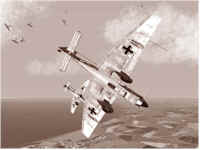
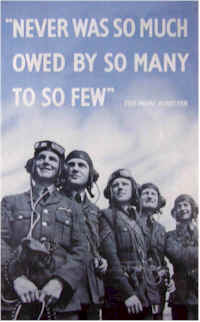
In the summer of 1940, the German
Luftwaffe (air forces) attempted to win air superiority over
southern Britain and the English Channel by destroying the Royal
Air Force and the British aircraft industry. This attempt came
to be known as the Battle of Britain, from Winston Churchill’s
"The Battle of France is over. I expect the Battle of
Britain is about to begin..." speech, served as crucial
turning point in the war. The Battle of Britain was the first
major campaign to be fought entirely by air forces. It was the
largest and most sustained bombing campaign attempted up until
that date.
Following the evacuation of
the British forces that helped defend France, and the
French surrender on 22 June 1940, Hitler believed the war
was practically over and the British, defeated on the
continent and without European allies, would quickly come
to terms with Germany. On 16 July, in an effort to finish
the war in the west, Hitler ordered the rapid preparation
of a plan to invade Britain in hope to frighten Britain
into peace by using the preparations as a means of
applying pressure. Britain’s failure to give into
Hitler’s bluff put the invasion into action. Hitler was
aware that the vast superiority of the British naval
forces eliminated any grounds for an attack by sea. As a
consequence, a German plan to neutralize the Royal Air
Force (RAF) was put into action. The entire elimination of
the RAF was the supposed to be followed with the strategic
bombing of the British navy so that Germany would gain
naval superiority and be able to proceed with an invasion.
The execution of this plan wasn’t as simple and rapid as
the Germans though it would be and so it turned into the
Battle of Britain.
In August the terrifying aerial battles
started to escalate, the Luftwaffe began launching attacks
of more than 1,000 aircraft in one day. They focused on
Britain’s airfield and radar installations, which were
vital in warning of the approach of the German aircrafts.
By the end of the first week in August, the RAF had lost
nearly 100 fighters and the Germans more than 190 planes.
During the last two weeks of August the RAF sustained
heavy losses but the German losses were greater. The RAF
roll of honor for the Battle of Britain recognizes 574
non-British pilots out of almost 3,000 in total, 84 of who
were Czechoslovakians.
By the end of the month the Germans had lost more than 600
aircraft and the RAF about half that number. But the loss of
experienced RAF pilots and the bombing damage done to the radar
stations had left Britain very vulnerable. If the attacks on air
installations had continued then the eventual outcome could have
been very different, but Hitler’s impatience soon shifted the
focus of his attacks. On 7th September Hitler resorted to terror
bombing tactics and ordered the Luftwaffe to bomb British
cities. On the 15th September more than 1,000 enemy aircraft
carried out a day and night attack on London, it was a day of
very heavy fighting and later became commemorated as Battle of
Britain day. On this day the RAF announced that they had shot
down 175 enemy aircrafts.
The attacks on British cities caused widespread damage and loss
of life. If German forces had continued to concentrate their
attacks on British air bases they might soon have overwhelmed
Fighter Command. But, as it was, German air chiefs overestimated
the number of British casualties and their bombers were being
shot down faster than they could be manufactured. Hitler needed
summer weather for his channel invasion, so as winter approached
with no breakthrough, the threat of invasion receded. Although
the fear of a German invasion was real, it was perhaps
unfounded, as German plans were in fact somewhat amateurish and
although the Luftwaffe proved very competent in this role, it
was not trained or equipped for the longer-range operations that
became part of the Battle of Britain. The failure of Nazi
Germany to reach its objectives, to destroy Britain's air
defence or to force Britain out of the war by forcing a
surrender, is considered the first major defeat of Nazi Germany.
Rudolf Kral
British International School of Bratislava