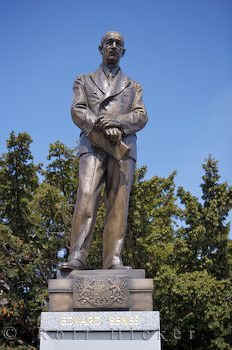
Born into a peasant family in a small village 60
km west of Prague on 26th May 1884, Edvard Beneš spent much of
his youth in Prague, attending a grammar school from 1896 to
1904. After his studies at the Faculty of Philosophy of the
Charles University, he left for Paris and continued his studies
at the Sorbonne and at the Independent School of Political and
Social Studies. He completed his first degree in Dijon, where he
received his Doctorate of Laws in 1908. Then he taught for three
years at the Prague Academy of Commerce, and after his
habilitation in the field of philosophy in 1912, he became a
lecturer in sociology at Charles University.
First exile, 1915 – 1918
During World War I, Beneš was one of the leading organizers of
an independent Czechoslovakia abroad. He organized "Maffia",
a Czech pro-independence anti-Austrian secret resistance
movement. In September 1915, he was exiled and in Paris he made
strong diplomatic efforts to gain recognition from France and
the United Kingdom for the Czechoslovak independence movement.
From 1916–1918 he was a Secretary of the Czechoslovak National
Council in Paris and Minister of the Interior and of Foreign
Affairs within the Provisional Czechoslovak government.
Czechoslovakia, 1918 - 1938
In 1918, Beneš represented Czechoslovakia in talks of the
Treaty of Versailles. From 1918–1935, he was the first and the
longest serving Foreign Minister of Czechoslovakia and from
1920–1925 and 1929–1935 also a member of the Parliament. In
1921 he became a professor and in 1921–1922 Prime Minister. In
years 1923–1927 he was a member of the League of Nations
Council, serving as president of its committee from 1927–1928.
He was a renowned and influential figure at international
conferences, such as Genoa 1922, and a member of the
Czechoslovak National Socialist Party, until 1925 known as
Czechoslovak Socialist Party. Being a strong Czechoslovakist, he
did not consider Slovaks and Czechs as separate
ethnicities.
In 1935, Beneš became President, succeeding
Masaryk. He tried to oppose Germany's claim to the Sudetenland
in 1938, but in October the crisis brought Europe on the brink
of war. Although the Munich Agreement signed by Britain and
France prevented war, it allowed for the immediate annexation
and military occupation of the territory by Germany. On 5
October 1938, after the Munich Agreement, Beneš was forced to
resign under German pressure and Emil Hácha became the new
President. In March 1939, Hácha's government was forced to
authorize the German occupation of the remaining Czech Republic.
By then, Slovakia had declare
Second exile, 1938 - 1945
For the second time, Beneš was exiled on 22nd October 1938, and
went to Putney, London. In 1940 he organized the Czechoslovak
Government-in-Exile in London, making Jan Šrámek a Prime
Minister and himself the President. In 1941 alongside with
František Moravec he planned Operation Anthropoid, with the
intent of assassinating Reinhard Heydrich. This was realized in
1942, and resulted into brutal German atrocities, such as the
execution of thousands of Czechs and the villages of Lidice and
Ležáky being wiped out. Although Beneš was not a Communist,
he also kept friendly relations with Stalin. In 1943 he signed
the entente between Czechoslovakia and the Soviet Union in order
to secure Czechoslovakia's political position, as well as his
own.
Second presidency, 1945 - 1948
After World War II, Beneš returned home and returned to his
former position as President. He was not elected President in
1945 but unanimously confirmed as the former president of the
republic by the National Assembly on 28 October 1945. On 19th
June 1946 he was formally elected to his second term as
President. The Beneš decrees, officially referred to as Decrees
of the President of the Republic, among other things,
dispossessed citizens of German and Hungarian ethnicity, and
created the base for the eventual deportation of the majority of
Germans to Germany and Austria. The decrees remain valid to this
day and are considered controversial, with the expellees
demanding their repeal. The Czech government has repeatedly
proposed that the decrees are no longer applied, and this view
has been accepted by the European Commission and the European
Parliament. Beneš presided over a coalition government
involving Democrats as well as Communists, having the Communist
leader Klement Gottwald as a prime minister. On 25th February
1948, the Communists assumed complete power in a coup d'état.
Beneš resigned as President on 7th June 1948 and was succeeded
by Gottwald.
Death, 1948
Edvard Beneš died peacefully of natural causes at his villa in
Sezimovo Ústí, Czechoslovakia on 3rd September, 1948. He is
interred along with his wife in the garden of his villa and his
bust is part of the gravestone.
Marek Rapant
British International School of Bratislava