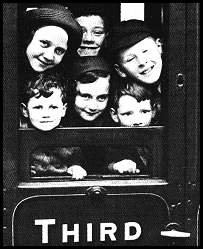
In 1939, as war became more and
more imminent, the British government grew concerned about the
threat of air raids and bomb attacks in London and other large
cities. It was decided that children, and in some case mothers
and teachers, should be transported, or evacuated, to safer
areas. British Evacuation began on 1st September, 1939, two days
before the declaration of war. It did not officially come to an
end until March 1946, although some returned home long before
this time. Approximately 3.5 million people were evacuated in
total, mostly children. They would be transported to the
countryside, where the threat of bomb attacks was significantly
less than in the cities, by train, bus and sometimes even boat.
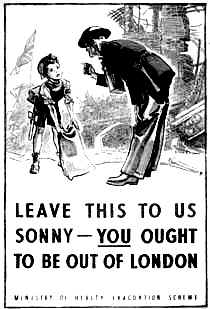
Evacuation was not compulsory,
but it was highly recommended by the government. Posters
explaining the benefits of evacuation were displayed around
towns and cities. Children below school age (under five years
old) had to be accompanied by their mother. Disabled adults were
also evacuated. Many families made private evacuation
arrangements, and sent their children abroad to countries such
as Canada, Australia and even Bermuda
Evacuees were distributed to
foster-parents, who would be expected to accommodate them
for the duration of the war. The experiences of evacuees
depended on the type of family they stayed with – those
who were evacuated to live with kind and welcoming
families took away many more positive memories when they
returned home. Often, moving in with new families involved
experiencing different social classes for the first time,
and was consequently an eye-opening, as well as
life-changing, experience.
On the day of evacuation children would usually assemble,
complete with name labels hanging round their necks, at a
train station. Encouraged by the government to bring as
little as possible, their suitcases would contain a
minimal amount of clothes, including a vest and
mackintosh, as well as soap, a facecloth and a toothbrush.
Billeting officers, who were in charge of finding homes
for the evacuees, paid money to families who agreed to
take in evacuees
Although moving away from homes and
families was difficult for evacuees, it was often equally
difficult for those who stayed behind. Many of those
evacuated before and at the start of the war returned home
in 1940 because there were no big bombing raids, but
during the Blitz of 1940, and during German attacks on
Britain in 1944, many had to be evacuated again as
conditions in cities grew increasingly dangerous.
Clare
Roberts
British International School of Bratislava