International
School History - International Baccalaureate - MYP History
MYP4
Last
update -
09 November 2017
Unit 1 - Lesson 4 - What was
feudalism? (from below)
How
can we find out about the lives of medieval peasants?
History is the study of what was written
in the past. Medieval peasants could not read or write
and therefore have left us no voice to listen to. The
knights and barons built castles and church leaders
built cathedrals, but medieval peasants lived in houses
made of straw and mud the remains of which have long
since been washed away. Where medieval peasants do
appear in the historical record, it is always from
someone else's perspective, someone from a higher social
rank in the feudal system looking down on them. The
names of peasants appear in manorial court records or
church court records and usually they appear because
they have done something wrong. Finding out about the
lives and thoughts of medieval peasants requires
imagination, a degree of detective work and historical
techniques more associated with the study ancient
history.
Europe in the middle ages was
overwhelmingly rural. The vast majority of people in
lived in the countryside. There were very few towns and
most people made their living from the land. Most people
lived in manors which was an area of land controlled by
a lord. The manor was an area of land that could
sometimes include more than one village.
The medieval village was very different from a modern
one. Few villages had more than 25 families. There
were no roads leading to it, only muddy track ways. Most
of the land in the village belonged to the lord of the
manor. The lord kept some of the land for his own crops;
this was called his demesne. The rest of his land was
let to the villagers.
Villagers grew their crops in vast open fields. Many
villages had three of these fields. But some had two;
others had four. Each field was divided into furlongs,
which were sub-divided into strips. A furlong is about
200 metres, which is about as long as a team of oxen can
plough a furrow without a break. A furlong means furrow
long.
Each family had some of these strips in each field (see
dark strips on the map opposite). That way, nobody got
all the good land or all the bad land. The lord, too,
had strips in these fields, as well as his own separate
land. Everyone in the village had to share the work.
Each year, one villager was chosen to be the reeve. It
was his job to organise the work.
From a thirteenth-century guide for manor officials
The steward
He should instruct the bailiffs who are beneath him. He
should visit each of the manors two or three times a
year and inquire about rents and services.
The bailiff
Every morning he should examine the corn, meadows and
woods. He should see that the ploughs are attached in
the morning so that they may do their proper ploughing
every day.
The reeve
The reeve should be chosen by the whole village. He must
see that everyone rise in the morning to do their work
and that the lands are well ploughed and sown with good
clean seed. He should each year with the bailiff work
out the services owed in the manor.
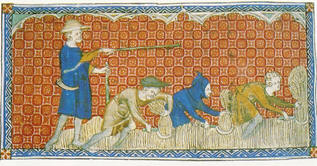
A medieval village reeve
The three field system
You cannot keep growing the same crops
on the same land unless you add fertilizer to the soil.
So each year the villagers grew a different crop in each
field. The main crops were wheat and rye (for bread),
barley (for beer), oats (for porridge or animal food)
and beans (for soups and stews).
Each year one field was left fallow. This means that no
seeds were planted in it. Instead, animals were allowed
to graze on the weeds which grew there. Medieval farmers
had no artificial fertilizers - so the animals did it
for them.
The peasants had to agree which crop was going to be
grown in each of the fields. This was usually fixed by
tradition, or in the manorial court. The villagers grew
all the food they ate, often with little to spare. If
the weather was bad, so was the crop. In a really bad
year, they starved. In 1316,during the Great Famine, many villagers had to eat
dogs and rats. They had no choice.
The village also had meadows, which were fenced. These
grew grass for hay. Once the hay had been harvested
animals were allowed to graze there. There was also
waste or common land which was used for grazing cattle.
As time passed, villagers chopped down more and more of
the woods. More land was needed for food.
The
peasant’s home
A villein's home was very poor by modern standards. Many
were just one-room huts, perhaps 6 metres by 4.5 metres.
The walls were made of woven branches called wattle.
This was covered with daub - a mixture of clay, dung and
straw. Animal hair was used to bind it together.
There were holes for windows and a hole for the door.
The floor was just the earth on which the house was
built. A fire stood on a lump of stone in the centre of
the room. Often there was no chimney. So smoke just
curled round the room. These poor cottages disappeared
centuries ago. Each probably only lasted for about 20
years. They had no taps. Water came from a nearby
stream. A pit in the garden did for a toilet.
Possessions
A villein was said to own 'nothing but his own stomach'
and was his master's possession.
There was hardly anything inside the villein’s home: a
few farming tools, cooking pots and bowls and perhaps a
table and some stools. Better-off peasants might have a
spare pair of clothes. Many did not. They might sleep on
bags of straw in the same clothes they wore by day. But
most pictures of the time show people sleeping naked.
At night-time, the villeins shared their floor with the
animals. The animals were the family's most valuable
possession. But the home was ideal for fleas to breed.
That goes for lice, too. People could clean their hair
with oatmeal, if they could spare it. Often, they did
not bother. As people sat gossiping in the evening, they
picked the lice from each other's hair. (They cleaned
their teeth, if at all, with hazel twigs.)
Control
Villeins were completely under the power of the lord of
the manor. In return for their land they had to give him
part of their crops and undertake labour service (work
without pay on the lord's land). They also had to do
other jobs such as weeding, hay-making, ditching and
repairing the mills.. The villeins had to attend the
manorial court. If they did not they were fined. They
also had to serve on the jury if chosen. They were not
allowed to leave the manor without the lord’s
permission.
Taxes
All the villagers had to use the
lord's mills for grinding their corn into flour. They
paid for this either with money or by giving the lord
some of their corn. If they were caught using a
hand-mill of their own they were punished in the
manorial court. He also had to pay the lord of the manor
before he could brew ale, bake bread, gather wood or
sell his animals. He could not fish or hunt except on
the common land. A villein also had to pay a tax called
a merchet (so his daughter could marry), and supply free
food when the lord's steward arrived to collect the
crops. When a villein died, the lord of the manor took a
tax called a heriot (which included his animals,
clothes, pots and possessions) and the Church took a tax
called a mortuary.
Women's lives
Medieval manuscripts were mostly written by men. They
tell us little about women's lives. Yet women played an
important role in village life. Married women led lives
which were probably harder than the men's. They were
expected to help their husbands in the farming work,
especially at harvest time. On top of that, they cleaned
the house, cooked and made clothes and brought up the
children. Many of the women brewed their own ale
(beer), but they could only sell it once it had been
tested by the ale tasters and at a price set by the
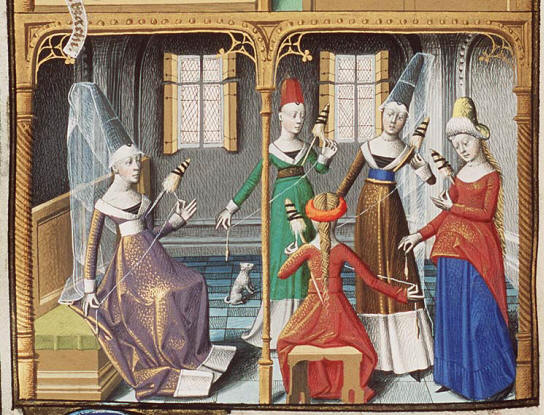
lord. The most common symbol of the peasant woman
was the distaff - a tool used for spinning flax and
wool.
In interpretations of the Bible, Eve
is often shown with a
distaff, illustrating her duty to perform manual
labour after the fall from Paradise. The church played
an important role controlling how women were expected to
live their lives and encouraging the misogyny they faced. According to the Bible, Eve was
created from Adam's rib and, having eaten the forbidden
fruit, was responsible for man's expulsion from
paradise. The writings of the apostle Paul, in
particular, emphasised men's authority over women,
forbidding women from teaching, and instructing them to
remain silent. The most important role of medieval woman
was childbirth which was a very dangerous undertaking.
The average life expectancy for a male child born in the
UK between 1276 and 1300 was 31.3 years. However, by the
time the 13th-Century boy had reached 20 he could hope
to live to 45, and if he made it to 30 he had a good
chance of making it into his fifties. Life expectancy
for women was considerably less.
1. Draw a sketch map to help you, explain how the three
field system worked and explain the various jobs of
responsibility in the medieval village.
2. Using both the film extract and the
text above, explain how and why the lives of medieval
peasant women were particularly difficult in the middle
ages.
3. Plan a detailed essay plan in
response to the debatable question, 'To what extent do
you agree with the view that 'being a peasant in the
middle ages was one of the worst jobs in human history'.
As well as the text above, you will also need to refer
to the Terry Jones video above.