In the
first lesson of the last unit I quoted Marx, you may
remember? 'It is not the consciousness of man
that determines his social being, but rather, his social
being that determines his consciousness.' We spent
most of the last unit illustrating this quote. We
explored how changes in society - towns, trade, disease,
technological development, exploration - created new
contexts in which new ideas (a new paradigm?) became possible. Feudalism
didn't begin to crumble, just because people had an idea
and wished it away.
However, Marx also wrote in another book, 'History
does nothing; It is men, real, living men... who possess
things and fight battles.' In other words, what
people think and do, does make a difference. This is
rather important for two reasons.
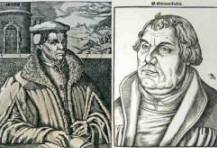
1. The historical events of the 1520s
were caused by people like Martin Luther and Thomas
Müntzer in Germany, 'real living men who fought
battles'. They thought about things and acted in
ways that were very dangerous for their health. Luther
expected to die for his ideas and Müntzer ended up with
his head on a pole. They knew it was dangerous, but did
it anyway.
2. Marxism is like Christianity, they are
both based on big books that can appear to say
contradictory things. As we will see, when people were
free to read and interpret the Bible themselves,
independent of the authority telling them what it meant,
those contradictions caused trouble.
Structure and Agency
The subject of sociology distinguishes
between the ability for individuals to shape
their world as agents, and their
inability to do so as a result of
socio-economic structures that limit
their autonomy.
The
Diet of Worms
The dramatic
events in Germany from 1521 to 1525, resulted from
fundamental causes which would cause similar dramatic
events across Europe for the next few hundred years.
The Diet of
Worms was a general assembly of The Holy Roman Empire
that took place in 1521 at Worms, a small town on the
river Rhine located in what is now Germany. It is most
memorable for the Edict of Worms which dealt with Martin
Luther and the effects of the Protestant Reformation.
The
previous year, Pope Leo X had issued the Papal bull,
outlining forty-one errors found in Martin Luther's 95
theses and other writings related to or written by him.
Prince Frederick III, Elector of Saxony obtained an
agreement that if Luther appeared he would be promised
safe passage to and from the meeting. Such a guarantee
was essential after the treatment of Jan Huss, who was
tried and executed at the Council of Constance in 1415
despite a safe conduct pass.
Emperor
Charles V began the Imperial Diet of Worms on 28 January
1521. Luther was summoned to renounce or reaffirm his
views; he appeared before the assembly on 16 April.
Luther was asked if a collection of books was his and if
he was ready to revoke their heresies He stated “They
are all mine, but as for the second question, they are
not all of one sort." Luther went on to place the
writings into three categories: (i) Works which were
educational and well considered useful by his enemies.
These Luther would not revoke. (ii) Books which attacked
the abuses of the papacy: to revoke those would be to
encourage the abuses to continue. “If I now recant
these, then, I would be doing nothing but strengthening
tyranny” (iii) Attacks on individuals: he apologized for
the harsh tone of these writings but did not reject what
he had taught; if he could be shown from the Bible that
he was mistaken, Luther continued, only then would he
reject them.
According to tradition, at the end of his
defence Luther said: ‘Here I stand; I can do no other.
God help me. Amen.’ Most historians now question whether
these words were actually spoken, however, since only
the last four appear in contemporary accounts. The full
sentence only appears in an account by Philipp
Melanchthon (him again!), one of Luther's strongest sympathisers, but
only the last four words are recorded in a similar
first-hand account by Johannes Cochlaeus who was a defender
of the church.
The Edict of Worms was issued on 25 May
1521 by Emperor Charles V. It made Luther an outlaw. But
because of rising public support for
Luther among the German people and the protection of
certain German princes, the Edict of Worms was never
enforced in all German territories. However, in the Low Countries
(comprising modern-day Belgium, Luxembourg, and the
Netherlands), the Edict was initially enforced among
Luther's most active supporters.
In December, 1521, Jacob Probst, prior
of the Augustinian monastery in Antwerp, was the first
Luther-supporter to be prosecuted under the terms of the
Worms Edict. In February 1522, Probst was forced to make
public recantation of Luther's teachings. Later that
year, additional arrests were made among the
Augustinians in Antwerp. Two monks, Johannes van Esschen
and Hendrik Voes, refused to recant and so on 1 July
1523; they were burned at the stake in Brussels. They
became amongst the earliest Protestant martyrs.
Edict of Worms
‘we forbid anyone from this time forward to
dare, either by words or by deeds, to
receive, defend, sustain, or favour the said
Martin Luther. On the contrary, we want him
to be apprehended and punished as a
notorious heretic, as he deserves, to be
brought personally before us, or to be
securely guarded until those who have
captured him inform us, whereupon we will
order the appropriate manner of proceeding
against the said Luther. Those who will help
in his capture will be rewarded generously
for their good work ‘