International
School History - International Baccalaureate - MYP History
MYP4
Last
update -
14 January 2018
Unit 2 - Lesson 2 - Outside
Christendom - The influence of the other
In our
last lesson we looked at the way that economic and
social development helped bring about new ways of seeing
the world. How ‘who we are’ is determined by ‘what we
are’. The development of towns in the Middle Ages
created social classes and a new urban consciousness
which over time weakened the feudal bonds and the power
of the church. This lesson is concerned with another
factor which often brings about change: outside
influences and in particular for medieval Europe, Islam.
In the year 610, Muhammad began
receiving what Muslims consider to be divine
revelations, these revelations were collected together
in the Quran (Koran). After Muhammad's death in 632,
Islam spread largely though successful military conquest.
By the 8th century, the Islamic empire extended from
Iberia in the west to the Indus river in the east.
Islamic society created many centers of culture and
science and produced notable astronomers,
mathematicians, doctors and philosophers during the
Golden Age of Islam.
In the first
video
for this lesson, Jacob Bronowski
in the classic 1970s documentary the Ascent of Man,
calls these outside Islamic influences on medieval
Europe a 'new impulse'. Bronowski explains how
the arrival of the later European Renaissance came about through the influnce of
Islam. He explains how Islam was not a religion
based on miracles but rather an 'intellectual content... a
pattern of contemplation and analysis'. Of all the great
contributions of Islam, Arabic numerals, algebra and
alchemy (chemistry) and the practical application of
theory to solving problem of travel (astrolabe) and
urban design in the towns of Al-Andalus (Muslim Iberia.)
were amongst the most important. Last lesson we examined
the importance in the growth of medieval towns. Cordoba
in Muslim Spain was a city of over half a million
inhabitants with street lighting and running water. At
the same time 10,000 Londoners lived in timber-framed
houses and used the river as their sewer. (For more see
BBC Bitesize)
Four key dates
Medieval Europe was known as
Christendom. In 1000 A.D., European awareness of the
world beyond western Europe was limited. But gradually,
over the next 500 years the outside world began to
penetrate and borders dissolved. There were also a
number of key events which accelerated the breakdown of
isolation and opened European society up to outside
influences. We are going to look at four dates.
1085 - The Fall of Toledo.
1095 - The First Crusade
1206 - Genghis Khan becomes ruler of all the Mongols.
1453 - The Fall of Constantinople
Activity 1
Watch the introductory video about
European geographical understanding and then consider
the following questions
here.
In 1085,The Siege of Toledo was a key
moment in the struggle between the Christians and
Muslims in the Iberian Peninsula. The city was the
capital of the Muslim Taifa kingdom of al-Andalus and
its fall to King Alfonso VI of Castile spurred the
Reconquista, the Christian conquest of Muslim Spain.
Raymond of Toledo, Archbishop of Toledo from 1126 to
1151, started the first translation efforts at the
library of the Cathedral of Toledo, where he led a team
of translators who included Arabic speaking Christians,
Jews and monks from the Order of Cluny. They translated
many works, usually from Arabic into Castilian, and then
from Castilian into Latin, as it was the official church
language. The work of these scholars made
available very important texts from Arabic and Hebrew
philosophers, whom the Archbishop deemed important for
an understanding of several classical authors, specially
Aristotle. As a result, the library of the cathedral,
which had been refitted under Raymond's orders, became a
translations center of a scale and importance not
matched in the history of western culture. Gerard of
Cremona was the most productive of the Toledo
translators at the time, translating more than 87 books
in Arabic science.
Of the many long term consequences
one example may stand for many: Nicolaus Copernicus, the
first scientist to formulate a comprehensive
heliocentric cosmology, which placed the sun instead of
the earth at the center of the universe, studied the
translation of Ptolemy's astronomical Almagest. Ptolemy
was a Greco-Roman mathematician and astronomer from the
2nd century AD. Copernicus also used the data for
astronomical computing contained in the Alfonsine
tables, of which he owned a copy after they were
published in Venice in 1515. The Alfonsine tables
provided data for computing the position of the Sun,
Moon and planets relative to the fixed stars. The tables
were named after Alfonso X of Castile, they had been
compiled in Toledo.
Toledo, Spain.
Activity 2
'The Greek philosophers like Aristotle
started from completely different assumptions to
traditional Christian philosophy.' Explain what Robert
Bartlett means by this, why the fall of Toledo was so
important and how the Christian church responded.
1095, Pope Urban II launches the First
Crusade.
The Crusades
generally refers to the set of seven distinct campaigns
over a 150 year period (A.D. 1095 to 1254) that were
enacted to liberate the Holy Land from Muslim control. In 1071 the Ottoman
Turks captured the Holy Land, stopped pilgrimages
and threatened the Eastern Orthodox Christian
(Byzantine) church led from Constantinople . The Pope
promised to help the Eastern Orthodox church. In 1095 he
preached a sermon which called on all Christians to win
back the Holy Land from the Muslims or Saracens as they
were often called. This is what the Pope said:
‘Brothers,
I speak as a messenger from God. Your fellow Christians
in the east desperately need help. The Saracens have
attacked them and have pushed deep into Christian land.
They are killing great numbers of Christians. They are
destroying churches and land. In the name of God, I beg
you all to drive out these foul creatures. Your own land
has too many people. There is not much wealth here. The
soil hardly grows enough to support you. Set out for
Jerusalem. Take that land from the wicked infidel and
make it your own. If you die on the journey or if
you are killed in a battle against these Saracens all
your sins will be forgiven at once. God Himself has
given me the power to tell you this. Some of you have
spent too much time fighting against your fellow
Christians. But now you must fight the Saracens. Let
bandits become soldiers. Soldiers who have been fighting
for money must now fight for heavenly riches.’ Pope Urban
II - 1095
Perhaps because of the
religious sanction, the Crusades were fought with a
brutality that was unusual, even for the Middle Ages.
Even before the crusaders left Europe, crusaders
massacred Jews, the traditional victim of Christian
intolerance. And when in the Holy Land, the whole
population of cities like Antioch, Ma'arrat al-Numan
(see right) and Jerusalem, were
slaughtered; of the massacre in Jerusalem, a
contemporary observed, “The knights could hardly bear
it, working as executioners and breathing out clouds of
hot blood.”
The Crusades were
certainly 'successful' in preventing the continued
expansion of Islam and they had a number of consequences
on Europe itself. Trade expanded, which resulted in
particular benefits for Italian city states like Venice
and their banking sector. It weakened feudal society because
it help stimulate trade and a money economy; and, of
course, many knights left Europe never to return.
Moreover, returning Crusaders brought new tastes and
increased the demand for spices, Oriental textiles, and
other exotic items; and with the traded goods came the
new ideas.
Activity 3
Using the videos and with reference to
the words of Pope Urban II, explain why so many
Europeans did 'take-up the cross' and go on Crusade.
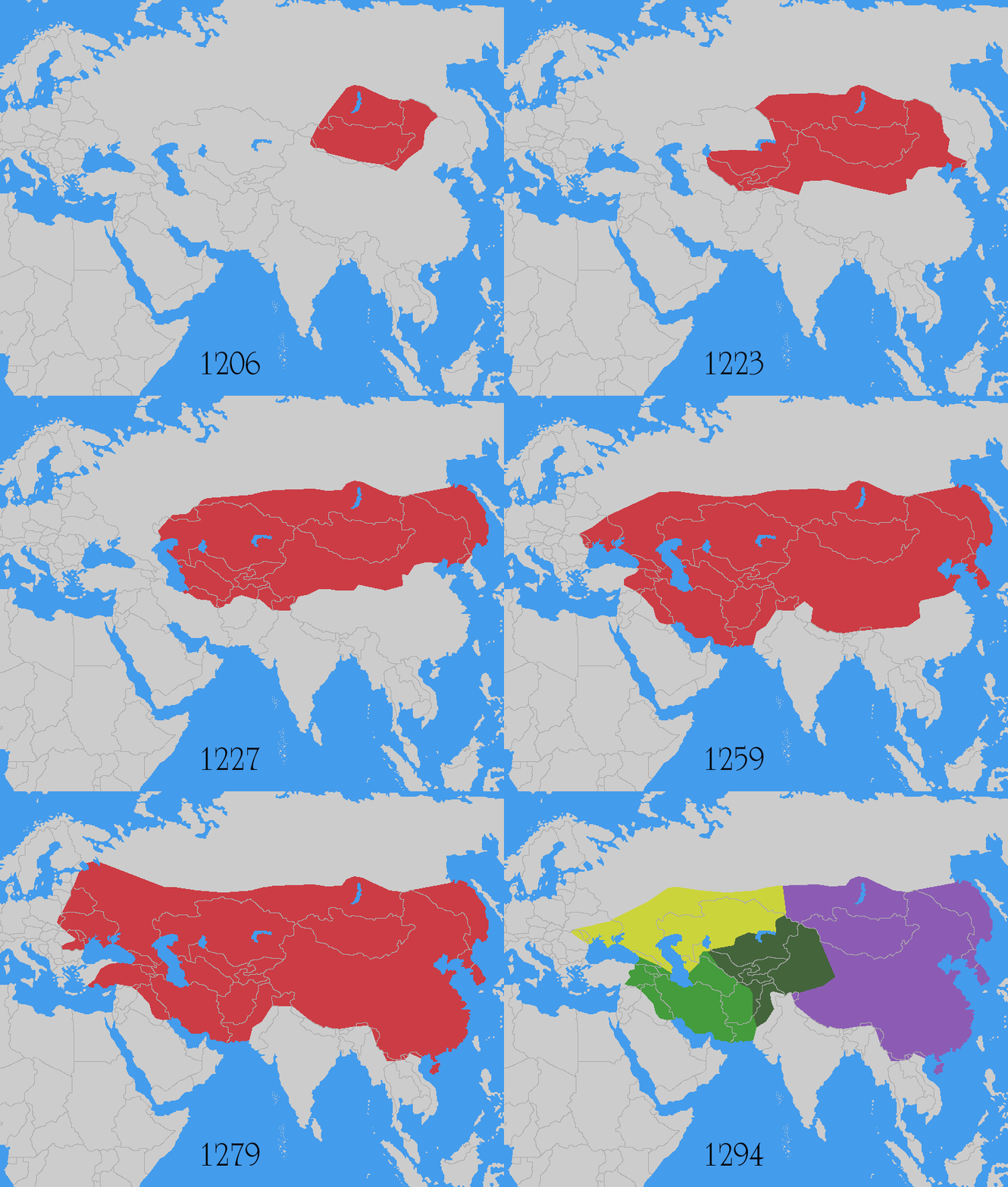
1206,
Genghis Khan, ruler of all the Mongols.
The Mongol Empire emerged from the
unification of nomadic tribes in the Mongol homeland
under the leadership of Genghis Khan, who was proclaimed
ruler of all the Mongols in 1206. The empire grew
rapidly under his rule and that of his descendants, who
sent invasions in every direction. They are famed for
their military prowess, but also for their savagery. Over
time, however, the empire encouraged trade and
guaranteed the safe passage of merchants. For the very
first time information and ideas and goods and people
could pass from Europe to China. The most famous route
made possible was the silk road. Venice and neighboring
maritime republics held the monopoly of European trade
with the Middle East. The silk and spice trade,
involving spices, incense, herbs, drugs and opium, made
these Mediterranean city-states phenomenally rich.
Venetian merchants distributed the goods through Europe
until the rise of the Ottoman Empire, which eventually
led to the fall of Constantinople in 1453, (See below)
barring Europeans from important combined land-sea
routes. Perhaps the most famous traveler along this
route was Marco Polo.
(Avove) the growth of the Mongol empire.
In 1270,
Marco Polo (at seventeen years of age), set off for Asia.
He returned to Venice in
1295, with many riches and treasures. He had travelled
almost 24,000 km. He was not he first European to travel
to China, but his adventures were the first to be documented in a book Livres des
merveilles du monde, also known as The Travels of
Marco Polo, c. 1300. This book caused a sensation, inspired Christopher
Columbus and many other travelers and encouraged the
development of European
cartography. When Colombus sailed in 1492, his missions
were to reach Cathay, the land of the Grand Khan in
China, and give him a letter from the monarchs Ferdinand
II of Aragon and Isabella I of Castile. One other
significant consequence, was that the Black Death that
devastated Europe (and helped bring about the end of
feudalism) in the late 1340s may have traveled
from China to Europe along the trade routes of the
Mongol Empire.
Activity 4
Using the videos and the text, explain
why the Mongol Empire was important to eroding European
isolation and also how it contributed to changed
European perspectives of the world.
1453 - The Fall of Constantinople
As we saw at the start of the course,
many historians consider the fall of Constantinople to
mark the end of the Middle Ages. John Green on Crash
Course History, even goes as far as to argue that the
Roman Empire didn't fully collapse until 1453 (see
right). Byzantium took on the name of Constantinople
after its re-foundation under Roman emperor Constantine
I, who transferred the capital of the Roman Empire from
Rome to Byzantium in 330 AD. From the mid-5th century to
the early 13th century, Constantinople was the largest
and wealthiest city in Europe. Until 1453 it was the
home to the Eastern Orthodox Christian church and the
most important centre of learning with the greatest libraries of Greek
and Roman literature in Christendom. When Constantinople
was taken over by the Muslim Ottoman Turks, scholars and
their libraries flooded western Europe, especially
northern Italy. This would be one of the main causes of
the Renaissance which was based on the rebirth of the
interest in classical culture and civilization.
Concluding Activity
Design a revision diagram
(table, mindmap, infogram...) about the importance of
the four dates we have studied in today's lesson. You
should focus on how each of these four factors
contributed to making changes to the medieval world. The
revision diagram needs to include the essential
information needed by any essay writer: the main points,
explanations and important facts.