Unit 3 - Lesson 6 -
Enlightened Science and Enlightened Despotism
What
was the Enlightenment?
The Enlightenment was an intellectual and cultural
movement of the seventeenth and eighteenth centuries. It
emphasised reason, logic, criticism and freedom of
thought over faith and superstition. One of the most
important features of the Enlightenment was the
Scientific Revolution.
What was the Scientific Revolution?
The Scientific Revolution is a concept used by
historians to describe the emergence of modern science
during the early modern period, when developments
in science transformed views about nature.
As we saw earlier this year, such a significant change
in the way the world was viewed has been termed by
Thomas Kuhn as a ''paradigm shift''. While its dates are
debated, the publication in 1543 of Nicolaus
Copernicus's On the Revolutions of the Heavenly Spheres
is often cited as marking the beginning of the
scientific revolution. It is a paradigm shift, because
the key assumption of a stationary earth surrounded by
moving heavenly bodies is replaced by a new heliocentric
view of the cosmos. The completion of the scientific
revolution is attributed to the "grand synthesis" of
Isaac Newton's 1687 Principia, that formulated the laws
of motion and universal gravitation, and completed the
synthesis of a new cosmology. How important was the
scientific revolution? The English historian Herbert
Butterfield wrote the following:
''Since that revolution turned the authority in English
not only of the Middle Ages but of the ancient
world—since it started not only in the eclipse of
scholastic philosophy but in the destruction of
Aristotelian physics—it outshines everything since the
rise of Christianity and reduces the Renaissance and
Reformation to the rank of mere episodes, mere internal
displacements within the system of medieval
Christendom....''
Six months ago I doubt whether you would have understood
much of what Butterfield is saying. Hopefully at least
some of it makes sense now?
Paradigm shifts (Again) - Deductive and Inductive
Logic
We have previously examined how medieval scholastics
like
Thomas Aquinas applied Aristotle’s logic to problems
of theological importance to the medieval mind. Should
Christians attempt to covert dog heads?, followed
impeccable deductive logic.
We should attempt to convert to Christianity all
creatures with souls
Dogheads have souls
Therefore we should try to convert dogheads.
This example of deductive reasoning is called a syllogism.
A syllogism is a deductive argument which arrives at a
conclusion based on two or more propositions that are
asserted or assumed to be true. A typical example said
to derive from Aristotle says:
All men are mortal.
Socrates is a a man.
Therefore, Socrates is mortal.
As long as the propositions are true, the conclusion
must be true. Because dogheads have souls we should try
and convert them.
An argument can still be valid even when the conclusion
is false, if one of the propositions is false.
All men have beards
Socrates is a man
Therefore, Socrates has a beard.
As we have seen earlier this year, the scholastic
paradigm assumed that the ultimate truth was found in
uncovering God's perspective as outlined in the Bible.
It also assumed that there were mysteries of the
universe that could never be understood. The medieval
deductive arguments were valid, but could result false
conclusions because they were based on questionable
propositions such as the existence of dog heads or that the earth is
the centre of the universe.
When Galileo posited a heliocentric view of the solar
system, he was going further than Copernicus and Kepler
(who worked out that planets do not orbit in perfect
circles), because his conclusions were based on
observations and measurements. These measurements were
made possible by technological developments in optics
that made it possible for Galileo observe and measure
the movement of the planets in ways that had previously
been impossible. It also made Galileo very dangerous to
the Catholic church, because his conclusions were not
simply propositions or theories but rather they were
proven by observation. This was a humanist perspective
that suggested that the truth was to be uncovered by
human observation of the natural world. This required a
different type of reasoning, inductive logic.
This would form the basis of the Scientific Revolution.
When reading through the list of great names of the
Scientific Revolution, it is worth noting that all of
them (with the notable exception of Galileo) were born in Protestant countries or ended up in
Protestant countries in order to work.
Inductive reasoning is a method of reasoning in which
the premises are viewed as supplying strong evidence
for the truth of the conclusion. While the
conclusion of a deductive argument is certain, the truth
of the conclusion of an inductive argument may only be
probable, based upon the evidence given. It is the
weight of evidence that matters. The great 20th century
Austrian/British philosopher Karl Popper summarized this
uncertainty with the principle of empirical
falsification. Scientific laws can never be proven, but
they should be assumed to be true until proven otherwise
(falsified).
The basic method of inductive reasoning is the
scientific method, which you are all familiar with and
which was developed at the start of the Scientific
Revolution by Francis Bacon.
Activity 1
Read the text above.
1. Explain the difference between
deductive and inductive logic. Do not cut and paste a
definition from the internet, you need to try and
explain it.
2. Watch the film about Galileo.
(a) How did Galileo prove the theories of
Copernicus and Kepler?
(b) How did Galielo get around the injunction not to
write in support of Copernicus?
(c) Why was Pope Urban VIII so upset by Galileo and why
did he feel the need to take action?
(d) How did Galileo defend himself?
(e) Why in the end did Galileo confess, with what
consequences for him and his book?
Who were the scientists?
Monty Python illustrate the flaws of
deductive reasoning.
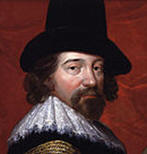
Francis Bacon
(1561-1626)
British. Bacon
believed that knowledge shouldn't be derived
from books, but from experience itself.
With inductive thinking,
he begins by observing the variety of phenomena
and derives general principles to explain those
observations. Empiricism emphasises the
importance of observable evidence produced in
support of a theory. Bacon is considered to be
the father of the scientific method:
1 Observe what
happens.
2 Develop a theory.
3 Devise an experiment to test the theory.
Repeat the experiment to ensure the same
outcome.
4 Observe and measure the results of the
experiment.
5 If the results do not fit, return to step 2
and develop a new theory.
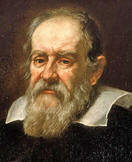
Galileo
Galilei (1564-1642)
In 1610 the Italian
mathematician, scientist and astronomer Galileo
became one of the first people to build and use
a telescope to observe the sky. He managed to observe the Milky Way, the Moon
and the orbit of planets in the solar system. He
concluded in his book of 1610, The Starry
Messenger, that his scientific observations
showed that Copernicus' theories, 67 years
earlier, were indeed correct.
This was to cause
a negative reaction from the Catholic Church
because these discoveries undermined the
teachings of the Church, and attacked the idea
that the Church and God were at the centre of a
perfect universe. In 1633 Galileo went through a
trial conducted by the Church, which led to him
being under house arrest for the last eight
years of his life!
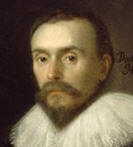
William Harvey (1578-1657)
British. Harvey worked to discover how the
heart and blood worked in the body. Prior to
this, scientists in Europe were believers in the
teachings of Galen, who was a Greek doctor from
the second century. Galen taught that the blood
was moved from the heart to all the different
parts of the body, where it was used up. William
Harvey's approach to Galen's teachings was to be
more scientific; he began to experiment and
measure scientifically how the blood moved
around the body.
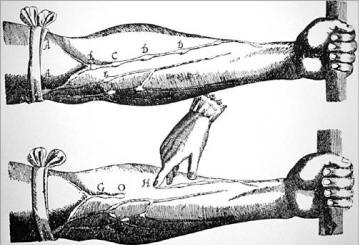
Harvey experimented in
order to discover how the blood circulated: • He
pushed thin wire down veins. • He cut up live
cold-blooded animals, such as frogs, to watch
how their hearts worked.• He made attempts to
pump blood past valves inside the veins. When he
failed he realised that blood only flowed in one
direction. • He took measurements of how much
blood the heart pumped.
Harvey's experiments had proved that the heart
pumped blood to the body through arteries and
the blood returned to the heart through veins.
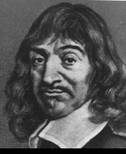
Rene
Descartes (1596-1650)
French
mathematician and philosopher. Descartes was a
deist who believed that God created the universe
as a perfect clockwork mechanism that functioned
thereafter without intervention. In Discours
de la Méthode (1637), he advocated the
systematic doubting of knowledge (scepticism),
believing as Plato that sense perception and
reason deceive us and that man cannot have real
knowledge of nature. The only thing that he
believed he could be certain of was that he was
doubting, leading to his famous phrase Cogito
ergo sum (I think, therefore I am).
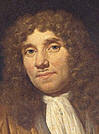
Antony van Leeuwenhoek (1632-1723)
Dutch. Antony Leeuwenhoek was a businessman and
scientist in the Golden Age of Dutch science and
technology, a friend and contemporary of
Johannes Vermeer. A largely self-taught man in
science, he is commonly known as 'the Father of
Microbiology'. He found that plant and animal tissues
were made out of rooms or cells, but they also
discovered tiny monsters in mud
puddles: hydras and amoebas. He was also the
first to document microscopic observations of
muscle fibers, bacteria, spermatozoa, red blood
cells, crystals in gouty tophi, and blood flow
in capillaries.
In 2004, a public
poll in the Netherlands to determine the
greatest Dutchman ("De Grootste Nederlander")
named van Leeuwenhoek the 4th-greatest Dutchman
of all time.
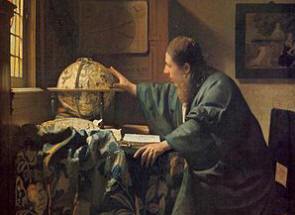
Vermeer - The astronomer
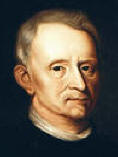
Robert Hooke (1635-1703)
British. Hooke was a professor of
geometry, an astronomer and designer of the
compound microscope. He described his invention
and other pieces of equipment, and made detailed
drawings from his observations of objects such
as the flea. In 1665, he
inspired the use of microscopes for scientific
exploration with his book, Micrographia. Based
on his microscopic observations of fossils,
Hooke was an early proponent of biological
evolution. Much of Hooke's scientific work was
conducted in his capacity as curator of
experiments of the Royal Society.
He investigated the phenomenon of
refraction, deducing the wave theory of light,
and was the first to suggest that matter expands
when heated and that air is made of small
particles separated by relatively large
distances.
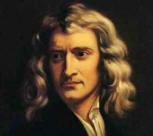
Isaac Newton (1642-1727)
British. Forty-five years after the death of
Galileo, the English physicist and
mathematician. Sir Isaac Newton published what
has been termed the greatest scientific book ever
written. The book, published in 1687, was called
Principia Mathematica and laid down the laws of
motion and gravitation. He is mostly remembered
for his law of gravity. The story goes that
after watching an apple fall from a tree he
began to wonder why it fell straight down and
did not just stay where it was, or move
sideways.
His theory of gravity, developed in 1686, showed
that all objects attract each other, depending
on their mass and distance apart. Therefore the
huge Earth pulls a small apple towards it by a
force called gravity.
>
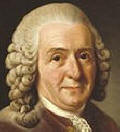
Karl
von Linné (1707-1778)
also known as Carolus Linnaeus.
Swedish. Linnaeus is considered to be the father of
taxonomy. In his Systema Naturae, published in 1767, he catalogued
all the living creatures into a single system
that defined their relations to one another: the
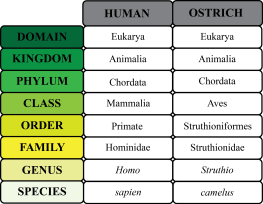
Linnean classification system. Distinct living
creatures he called "species," which means
"individuals." Related species were called a
"genus," which means "kind." And so on up a
scale of more abstract relationships: family,
class, order, phylum, and kingdom.
Each individual
species was marked by both its species and its
genus name; this classification system, with
some modifications, still dominates our
understanding of the living world.
Activity 2
Design a timeline of the scientific
revolution, which includes all the scientists listed
above. You need to indicate their life span (birth and
death date) so that you can see how many scientists were
contemporaneous. And you need to include a sentence or
two to summarize their main scientific contribution. The
film at the top of the page will also help with this.
Click on the image below to see a sample of good
timelines from previous years.
Absolute Monarchies and Enlightened
Despots
Absolute monarchy is a form of monarchy in which one
ruler has supreme authority and where that authority is
not restricted by any written laws, legislature
(parliament), or customs. Many European monarchs,
claimed supreme autocratic power by divine right, and
that their subjects had no rights to limit their power.
This is what political scientists call 'traditional
authoritarianism', because power was passed on from
father to son, through time and through one family. In
some European countries, this form of government lasted
until the 20th century. As an inherited power,
traditional authoritarianism can be distinguished from
modern authoritarianism, which emerged after World War 1
with the rise of authoritarian political parties, such
as the Nazis in Germany. There are still some absolute
monarchies in the world today, mainly in the Middle
East.
As a form of government, they emerged in Europe in the
16th century as new nation states sought to centralize
and strengthen their power against enemies abroad and
opponents within. Typically this meant imposing one
religious faith and weakening towns, regional nobility
and representative assemblies. In some countries,
notably Britain as we have seen, this failed as Britain
became a constitutional monarchy. In other countries,
like France, Prussia (northern Germany) and Russia, it
succeeded.
In the 18th century a number of absolute monarchs came
under the influence of the ideas of the Enlightenment
and they sought to rule according rational and
scientific principles of good governance. These
monarchs have become known as enlightened despots. They
enjoyed the despotic power of absolute monarchs but
ruled with the general interests of the nation in mind.
Activity 3
Absolute Monarchs
balloon debate. Who was the greatest of the Absolute
Monarchs of the 17th and 18th century? This is an end of
Unit Test that will assess your ability to research and
debate.