International
School History - International Baccalaureate - MYP History
MYP4
Last
update -
20 March 2018
Unit 2 - Lesson 5 - The
Renaissance: more than
Italian painters
Let's start with how this is usually
taught and what you probably know already...
What was the Renaissance?
The
Renaissance (French for 'rebirth'; Italian: Rinascimento,
from ri- 'again' and nascere 'be born') was a cultural
movement that spanned roughly the 14th to the 17th
century, beginning in Florence in the Late Middle
Ages and later spreading to the rest of Europe.
Traditionally, this intellectual transformation has
resulted in the Renaissance being viewed as a bridge
between the Middle Ages and the Modern era. Although the
Renaissance saw revolutions in many intellectual
pursuits, as well as social and political upheaval, it
is perhaps best known for its artistic developments and
the contributions of such polymaths as Leonardo da Vinci
and Michelangelo, who inspired the term 'Renaissance
man'. In the Middle Ages, people had looked to the
Church as the source of all knowledge to guide and
direct them. During the Renaissance, the Church still
played an important part in people's lives, but scholars
and intellectuals also looked back at the lives and
teachings of the Ancient Greeks and Romans.
Why did it begin?
This is what
this unit of study is all about but, in brief: various
theories have been proposed to account for its origins
and characteristics, focusing on a variety of factors
including the social and civic peculiarities of Florence
at the time; its political structure; the patronage of
its dominant family, the Medici; and the migration of
Greek scholars and texts to Italy following the Fall of
Constantinople at the hands of the Ottoman Turks.
Italy was particularly badly hit by the plague, and it
has been speculated that the familiarity with death that
this brought caused thinkers to dwell more on their
lives on Earth, rather than on spirituality and the
afterlife. With the invention of the printing press
around 1450 and increasing literacy amongst the
population, the seeds were sown for future change.
If we were to choose
one invention during this period that was to change the
world and take Europeans out of the Middle Ages it would
have to be the invention and development of printing.
The printing of books led directly to the increased and
faster circulation of books and ideas throughout Europe.
Consequently the influence the Church had over people's
lives decreased because it could not control the ideas
they picked up through their reading.
The Chinese had invented printing using blocks of wood,
over 700 years before the first printing press went into
production in Europe in around 1450. Over time, they
developed their printing methods and started using
movable letters. However, this invention was slow to
reach Europe. At this time, books were beautifully
hand-written and illustrated (decorated), with fine
pictures and colours. They were written on vellum
(animal skin) - a book of 200 pages would need the skins
of about 100 sheep. As a result, books were very
precious and rare, and were used only by the wealthiest
people in society.
In 1438 a German
craftsman named Johann Gutenberg and three partners
contracted to develop printing techniques. By 1450
Gutenberg had refined his techniques enough to convince
a Mainz merchant, Johann Furst, to sponsor his work. So
it was that in 1450 the first printed version of the
Bible was produced using the new method of printing with
movable type invented by Gutenberg. The printing process
consisted of a mould in which thousands of letters of
equal sizes could be cast from hot metal.
Gutenberg learnt this skill in metalwork
from his uncle, who was a master of a mint where money
was made. Lines of letters were laid out and locked
firmly together in a frame by wooden cases in order to
make up a whole page of words. This is where the terms
‘upper case’ and ‘lower case’ come from. This page of
movable type was then fixed into a printing press,
possibly one developed from a wine or cheese press. A
piece of paper was then placed over the inked type and
held in place by a paper holder. The paper, paper holder
and type were then slid into the press, where a large,
flat, wooden plate was lowered on to the paper by
turning a huge wooden screw on the printing press. This
pressed the paper firmly down on to the inked type to
print the page. A press of this kind could print about
300 pages a day.
Other businessmen quickly followed Gutenberg. William
Caxton set up the first English printing press in 1476,
in the precincts of Westminster Abbey. He was a
travelling London mercer (cloth merchant), who picked up
the skills of printing from his visits to the
Netherlands and Germany. He was successful in producing
a series of books in English, including some of his own
translations. One famous book printed at this time was
Chaucer's Canterbury Tales, in 1484. The printing of
books and pamphlets became common over the next century.
More and more people began to voice new ideas and wished
to pass on their views to a wider and more literate
public. In this way the development of the printing
press was a major factor in the Renaissance movement. Up
to this point the Church was, by and large, the main
producer of written documents, controlling what was
read. With the invention of printing the opportunities
for the spread of new ideas and free speech grew, but
for those people who criticised governments and
prominent people life could be dangerous.
Why did it begin in Italy?
In the
middle of the sixteenth century, Italy was divided into
about 200 city states. Each city state was made up of a
powerful city that controlled the weaker towns and
countryside that surrounded it. The city states raised
their own taxes, made their own trade laws and built
fortifications and defences. Some of these cities, such
as Florence, were republics where the people had power
and a say in how the city state was run and there was no
monarchy. This type of government was very similar to
that of Ancient Greece and Rome. The leaders of the city
states were called signori and they had huge power which
many passed on to their families. One of the most famous
of the signori was Cosimo de 'Medici. He became a patron
of the arts (someone who gives backing and assistance,
usually financial aid). Patronage was often given to
glorify God as well as improve a patron's city because
it enabled cathedrals and churches to be built and
decorated
Painting and architecture
This is the
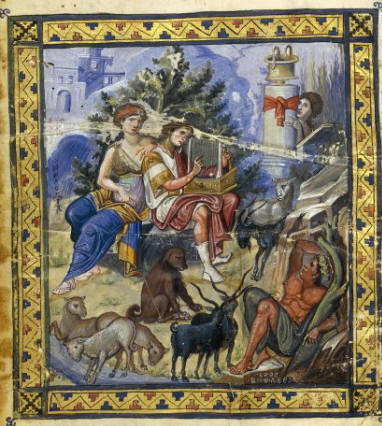
thing you probably remember. During the Middle Ages the
subjects of paintings looked flat and lacked any feeling
of movement. Sculptures were often shallow carvings,
called bas-reliefs and were used to decorate walls and
other stonework. Medieval artists focused on the
religious meaning of their work and did not try to make
their subjects appear life-like. (see below) Painters
like Michelangelo (1475-1564), Raphael (1483-1520),
Leonardo da Vinci (1452-1519) learned new techniques to
make accurate drawings of people, animals and plants.
Leonardo da Vinci even drew cut-up bodies so that he
could learn the shape of the muscles under the skin and
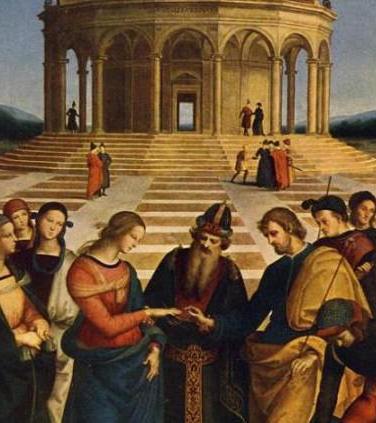
paint more realistic figures. Artists like Raphael
adopted a new style in their work. Paintings now had
perspective, which meant that objects in a picture
looked the same in relation to each other as they did in
real life. Filippo Brunelleschi (1377-1446) was one of the
first to bring the laws of perspective into practical
use in the design of buildings (see right). Most of his work was
done in Florence - for example, the Foundlings Hospital
and the cupola of the Duomo. One of the
most impressive Renaissance churches is St Peter's
Basilica in Rome, the biggest Christian church in the
world. In 1506, Pope Julius II decided to rebuild it and had
the original church demolished. The cost of rebuilding
was very great and some of the money was raised through
the selling of indulgences, something that Martin Luther
will be very critical of
next lesson.
The Medieval
- Paris Psalter
The
Renaissance - Raphael’s ‘Betrothal of the
Virgin’
Humanism and the
break from Scholasticism
When we speak of
humanism today we mean people who reject the idea of a
god and prefer to explain the world through human
reason. Humanism during the Renaissance was different. Humanism
was an educational philosophy that wanted to change the
intellectual life that had dominated medieval Europe. As
we have seen, medieval thought was restricted to
thinking about issues raised by the study of Christian
doctrine, especially after new Arabic translations of
classical Greek texts began to appear and challenge
Christianity after the Fall of
Toledo in 1085. (see
lesson two). Medieval intellectuals
could be concerned with complex problems and would
employ highly rational thinking. This intellectual
world restrained by the limits of Catholicism we call
'Scholasticism.'
Scholasticism -
Aquinas incorporates Aristotle
The greatest
philosopher of the medieval period, Thomas Aquinas,
explained what happened during the Eucharist, one of the
seven Sacraments. The problem to be solved was very
practical. Why, during the Eucharist does the bread and
wine not appear to change into the body and blood of
Christ, after it is blessed? To explain this Aquinas
used the Ancient Greek philosopher Aristotle. Aristotle
argued there are two qualities to every object: its
outer appearance that our senses can detect, (smell,
taste, hear etc.) and its inner nature or fundamental
structure that we cannot simply detect. The outer
appearance changes all the time. For example, a chair
can be made of wood or metal, but this is not essential
to its being a chair: that is, it is still a chair
regardless of the material from which it is made, these
variations were called accidents. The fundamental
property of all chairs, its inner essence - its
‘chairiness’ - Aristotle called its substance. The
substance of an object cannot be detected by the senses,
because to imagine a chair is to see a particular chair.
So how did Aquinas use this? What happens during the
Eucharist is that the accidental properties of the bread
and wine do not change, but the substance - its
‘breadiness’ - does change in to the body of Jesus: the
substance is changed, it is ‘transubstantiated’. Voila.
Logical, rational and very learned. Medieval minds were
not less logical or intelligent than ours!.
Its all about assumptions. If you assume there is a
singular God, and that the word of God is contained in
the Bible, that the Pope is God’s representative on
earth and he and his priests interpret God’s will for
us, then why would you think beyond these assumptions?
These assumptions were unquestioned, hidden assumptions,
but hidden in plane sight. Scholasticism rationalised
and explained these assumptions. Humanism challenged
them.
Activity 1 - Scholasticism
Read the text and watch the video extract above. Explain
how Aquinas used Aristotle's ideas to help reinforce the
concept of transubstantiation. Why is this a good
example of scholastic thinking?
Humanism
Rather than learning
methods and logic to explain and defend Christianity,
Humanism, was concerned with knowledge itself and in
particular, knowledge about humanity. That meant that
humanists were interested in subjects like poetry,
language (especially ancient Greek) and history. This is
what we mean when we say we study the 'humanities'
today. One of
the most significant consequences of the Fall of
Constantinople in 1453 had been the arrival not only of the
books from the greatest libraries in Europe, but
teachers who were familiar with the Ancient Greek
necessary to translate them. At almost the same time as
it became possible to print and spread a new knowledge
that was not controlled by the church, new knowledge
became abundantly available.
Humanism was the
original rallying call to think outside of the box. If
the box was Catholic orthodoxy and Scholasticism was a
thinking that fitted inside the box, humanism looked
down at the box and laughed at how everything looked so
square. A lot of what is remembered about humanism
concerns how humanists made fun of the church. Humanists
were often university academics who laughed at the
ignorance of the priests and the strange superstitions
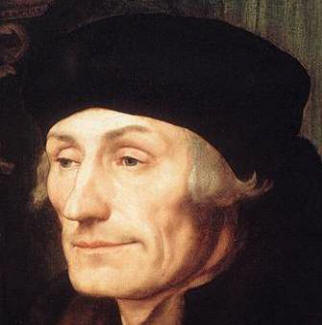
of church ritual. The most famous of them, Erasmus made
fun of how the priests 'brayed like donkeys in church,
repeating the words of psalms they don't understand'.
The name Erasmus today
is associated with the European Union project that
allows students within the EU to study for part of their
degree in another European country. (The project began
in 1987, so it is possible that some of your parents were
Erasmus students.) The project is well named because
Erasmus was a scholar who travelled and studied in many
European countries. But he was was more than an
itinerant master of satire. He was a serious, brilliant
scholar who produced a new translation of the Bible from
Greek manuscripts he had found in Basel and England.
Published in 1516, Erasmus’s Bible changed how a number
of key words had been translated and even suggested that
some sections of the Bible had been added at a later
date. For example, in one
critical passage the the word ‘repent’ was replaced with
‘come to your senses’. With this change, the whole
ritual of penance, so central to church orthodoxy, was
open to question. This was something Martin Luther would
pick up on later. In 1522, the English scholar William
Tyndale began work on an English translation of the
Bible based on Erasmus's earlier publication. Its
importance to both English history and the English
language cannot be overstated.
Activity 2 - Translating the Bible from the Greek.
Read the text and watch the video extract above. How had
the
Fall of Constantinople
in 1453 led to the translation of Tyndale's Bible? Why
was it such a revolutionary book?
Perspective is what students remember about the
Renaissance, because to our eyes perspective is
obviously more modern. The we say ‘modern’, we mean more
like us and what we have become. But perspective is also
enormously symbolic, this one development can be used
to stand for everything the Renaissance
is about. It was the application of mathematical
knowledge to the problem of representing three
dimensional reality in a two dimensional space. And yes,
medieval man didn’t know how to do that. But they had no
reason to know that. Medieval art wasn’t interested in
the perspective of man, how man saw the world. Medieval
art was concerned with God’s perspective, how God saw
the world and trying to logically make sense of that.
That is a scholastic perspective. In contrast,
Renaissance art was very much a human perspective, less
interested in the unchanging and eternal, more concerned
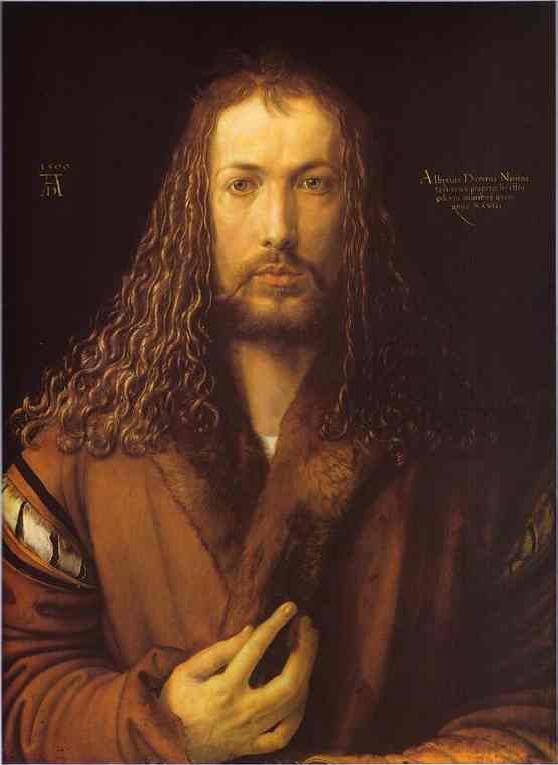
with the dynamic and ephemeral. It might be argued that
the most significant painting of the Renaissance was
Albrecht Dürer's self portrait of 1500. Not only were
self-portraits by artists rare, a self-portrait in which
the artist looks out directly at the viewer was
unprecedented. But even more than that, Dürer
deliberately paints himself in the style of Jesus. See the Khan Academy on the
self portrait.
Like Erasmus, Dürer
was a self publicist who printed and sold cheap copies
of his work to the general public.
Like Erasmus, Dürer made fun of the church. His
woodcuts which could be mass printed were remarkable for
their detail but also their subject matter. His
Apocalypse series includes this image which shows
the angels punishing Alexander VI (more about him next
week) and the Holy Roman Emperor, Maximilian I.
Dürer was also a
direct link between the humanism of the Renaissance and
the German Reformation. In 1520 he wrote of his desire
to draw Luther: 'And God help me that I may go to Dr.
Martin Luther; thus I intend to make a portrait of him
with great care and engrave him on a copper plate to
create a lasting memorial of the Christian man who
helped me overcome so many difficulties.' And finally,
like so many humanists, Dürer was concerned with the
science behind techniques of the Renaissance and did
much to popularise it. (Video)
Which leads us on to...
For centuries, scientists and philosophers had accepted
the work of Ancient Greek and Roman philosophers such as
Aristotle and Plato, which they interpreted in the light
of Christian belief. (Scholasticism) But now Renaissance astronomers now
used the new scientific methods of experimenting and
observation to study the skies. It was their sensational
discoveries which shook European beliefs about the
world. American physicist and philosopher Thomas Kuhn
(1922–1996) described this process as a 'paradigm
shift'. By 'paradigm' he means the scientific
assumptions (and methods) that underlie what (and how)
we know the world. The scholastic paradigm assumed that
the ultimate truth was found in uncovering God's
perspective as outlined in the Bible. This was replaced
by a humanist perspective that suggested that the truth
was to be uncovered by human observation of the natural
world.
The ancient
Greek philosopher Pythagoras (c.570-495 BC) proved that
the Earth was round and Aristarchus suggested that the
Earth and planets revolved around the Sun. However,
these ideas were replaced by Ptolemy's theories of the
universe written in about AD100. Ptolemy was an Egyptian
mathematician, astronomer and geographer who believed
that the planets and stars all revolved around the
Earth. This 'geocentric' theory fitted well with the
Church's ideas of the heavens being a circle, because it
was the 'perfect' shape. It also fitted with the idea of
the Earth (God's creation), the Church and God himself
being at the centre of the universe.
It wasn't
until the beginning of the Renaissance in Europe that
scientists and astronomers started to challenge existing
theories about the orbit of the planets. One person who
began to doubt Ptolemaic theory was Nicolaus Copernicus
(1473-1543), a Polish-German astronomer. Copernicus used the data for astronomical computing
contained in the Alfonsine tables, of which he owned a
copy after they were published in Venice in 1515. The
Alfonsine tables provided data for computing the
position of the Sun, Moon and planets relative to the
fixed stars. As we have seen in
lesson
2, the tables were named after Alfonso X of Castile,
they had been compiled in Toledo. In 1543, he published
his book The Revolution of the Heavenly Orbs. In it he
said people should assume that the Earth moved around
the Sun. This 'heliocentric' theory, which put the Sun
not the Earth at the centre of the heavenly stage,
aroused fierce religious opposition. Later scientists
went on to prove scientifically that Copernicus'
theories were correct.
Activity 3 - Paradigm shifts in science
What is meant by 'paradigm shift' and why was
Copernicus's
theory a good example of how a paradigm had shifted?
The Northern
Renaissance
The Northern
Renaissance was the less well known Renaissance that
occurred outside of Italy in the 15th and 16th
centuries, with important centres in Germany, France and
especially modern day Belgium and Holland.
Key
differences
with the Italian Renaissance:
The Northern
Renaissance artists, however, were scattered about and
few in number initially (very unlike their Italian
counterparts). The north had fewer rich city states than
did Italy. Italy, as we saw, had numerous Duchies and
Republics which gave rise to a wealthy merchant class
that often spent considerable funds on art. This
generally wasn't the case in the north. In fact, the
only notable similarity between northern Europe and
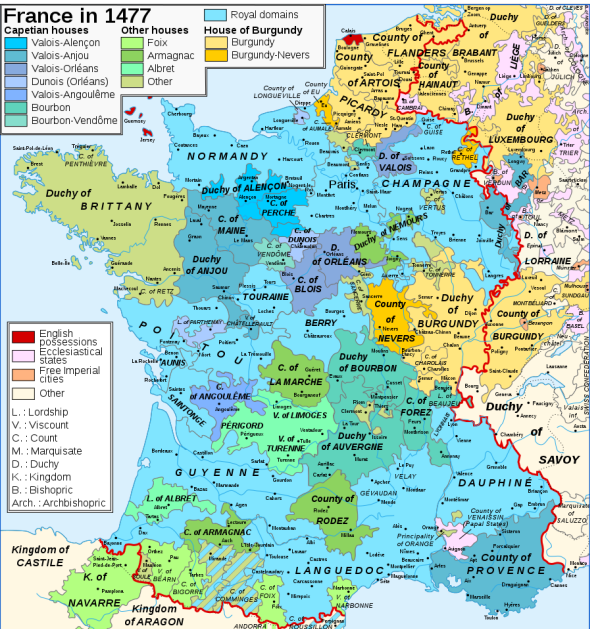
Florence, lay in the Duchy of Burgundy. Burgundy, until
1477, encompassed a territory from present-day middle
France northward (in an arc) to the sea, and included
Flanders (in modern Belgium) and parts of the current
Netherlands.
Renaissance
artists in the north took a different approach to
composition than Italian artists. Where an Italian
artist was apt to consider scientific principles behind
composition (i.e., proportion, anatomy, perspective)
during the Renaissance, northern artists were more
concerned with what their art looked like. Colour was of
key importance, above and beyond form. In addition,
detail was also very important.
Key
similarities
Apart from
the religious themes, the importance of new printed
literature and the fact that most artists came through
the guild system, the main similarity between the
Northern and Italian Renaissance was the existence of an
artistic centre. In Italy,
artists looked to the Republic of Florence for
innovation and inspiration. In the North, the artistic
hub was Flanders. Flanders was a part of the Duchy of
Burgundy. It had a thriving commercial city, Bruges,
which (like Florence) made its money in banking and
wool. Bruges had cash aplenty to spend on luxuries like
art. And (again like Florence) Burgundy, on the whole,
was governed by patronage-minded rulers. Where Florence
had the Medici, Burgundy had dukes.
The Northern
Renaissance artist who is largely credited with
developing oil techniques was Jan van Eyck, court
painter to the Duke of Burgundy. It's not that he
discovered oil paints, but he did figure out how to
layer them, in "glazes," to create light and depth of
colour in his paintings.
This fantastic
website allows for an extraordinary close up of the
Ghent Altarpiece.
Three other key Netherlandish artists were
the painters Rogier van der Weyden and Hans Memling, and
the sculptor Claus Sluter. Van der Weyden, who was the
town painter of Brussels, was best known for introducing
accurate human emotions and gestures into his work,
which was primarily of a religious nature.
Other early
Northern Renaissance artists that created a lasting
influence were the enigmatic Hieronymus Bosch (who we
have already seen and will see again) and Pieter Bruegel the Elder.
Activity 4 - The Ghent Altarpiece
Watch the film above on the Ghent Altarpiece. Why do you
think many experts consider it to be the most important
painting ever created? Include at least three reasons in
your answer.