International
School History - International Baccalaureate - MYP History
MYP4
Last
update -
10 May 2018
Unit 2 - Lesson 6 - The
Reformation
500 years ago in 1517, a monk called
Martin Luther may, or may not have, nailed a document (his 95 Theses) to the
church door at Wittenberg. This event led to a split in
the European church which changed the world.
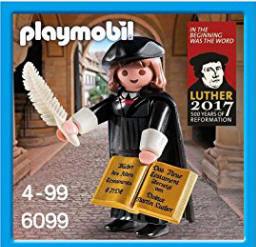
It was called the Reformation. 500 years later in 2017 a playmobil toy of Martin Luther
became the
bestselling toy in the company's history, shipping
over 1m examples at last count. This lesson hopes to
explain why a single event and a single document could
be so important. In short, the answer is, they weren't.
As is often the case, it's what came before (and after)
that make the events of 1517 so important.
As we discussed in our
first lesson this year, history is more than the
past, because the past has no meaning. The job of
historians is to use the known events of the past and to
organize these events into narratives (stories) that
give the past meaning.
If we are to understand the importance
of 1517 and Playmobil sales, we need to understand how
it can be fitted into a story of what came before and
what came after. First of all, the event itself,
courtesy of Joseph Fiennes and Hollywood.
500 Years
How is the world commemorating the 500th
anniversary?
Time magazine
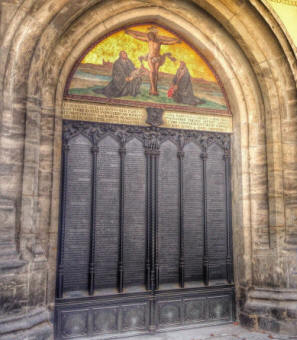
Luther probably never nailed the 95
Theses to the door, although if you visit the church
today you will see that in 1858, the wooden doors were
replaced with bronze (see right), inscribed with the
Latin text of the 95 theses. The story of
the Theses being nailed, was first written by one of
Luther's fellow professors at Wittenberg, Philip
Melanchthon. Melanchthon wasn't in Wittenberg in 1517
and waited after Luther's death before including the
nails and door in his story. So if this legend is not really very important,
what is?
Martin Luther and the Reformation
In brief,
Martin Luther (1483-1546), was the first reformer to
lead a large number of people to openly and
successfully, break with the church in Rome. As we have seen, during
the Middle Ages the powerful authority of the church had
extended over all areas of political, economic, social
and cultural life. The Reformation did much to destroy
this control. The Reformation was a revolt against the
authority of the Catholic Church in Rome. The
Reformation was also a rebellion against the corruption
and abuses in the church and the interference of the
leader of the Church - the Pope - in non religious
affairs. Those who rebelled, protested against the Pope
and demanded a
reform of the church were called ‘Protestants’.
Luther was a native German who became
a monk at the age of twenty-two and 1510 he was sent to
Rome, an event that marked a turning point in his life.
In 1512 he was appointed
as professor of theology in the University of
Wittenberg. He questioned the sale of indulgences in
1517 by agents of Pope Leo X, who were collecting money
for the construction of St. Peter’s Church at Rome.
Activity 1 - Luther's ideas
Watch the video extract above. Make a list of the
criticisms of the Catholic church that are illustrated
by the film.
In 1520, Luther
was excommunicated by Pope Leo X who requested that the Holy
Roman Emperor, Charles V punish him as a heretic.
Luther was asked to come before the Imperial Diet
(Church Council) at Worms in 1520-21, where he refused
to take back anything he had said. He advocated that "it
is neither right nor safe to act against conscience".
Such heresy, as we shall see, usually resulted in
burning at the stake. But Luther got
away with it. There were several people in Germany who
protected him. Frederick III, of Saxony hid Luther at
Wartburg Castle at Eisenach from 1521 to 1522 and
succeeded in defying the emperor and also the Pope. The
consequences are both hard to underestimate and almost
impossible to summarize (see next unit); war, civil
war and revolution would divide the European continent
for hundreds of years and divisions between Protestants
and Catholics still explains the political geography of
Europe today. But it also had a number of positive
consequences: it helped advance still further the cause
of Humanism (see
last lesson), it encouraged literacy
and development of the written vernacular (German, English,
French) language etc. and it undermined still further the
feudal system in which political authority and the
influence of the church went hand in hand. Perhaps most
importantly, the Reformation helped to change Europeans.
The Reformation encouraged Europeans to be individuals
who thought for themselves.
Understanding causes is central to what history is
about. Historians like to link different events together
that share something in common. For example, as we saw
in
Unit 1, historians use categories like political,
economic, social and cultural (PESC) to explain clearly
why things happen. Another way of organizing causes (and
consequences) is to divide them into long-term and
short-term. Long-term causes take place a long-time
before the event and are not an obvious, direct cause of
the event. They often provide the context in which the
event is more likely to happen. Short-term causes happen
immediately before the event and are obviously and
directly linked to the event.
Long-term causes
First a short detour into philosophy
(again).
Unit 2 has all been about the long-term, contextual
causes of the Reformation. However, the history covered
by these lessons, for example the Black Death, is
significant not simply because of what it helped cause
later. This is to be overly teleological. These events
are important in their own right. But, if we are to
fully understand what came later, we can only do so in
the light of what came before. These are long-term
causes of the Reformation then, because these events
happened a long-time before the Reformation and are not
obviously connected to it.
Teleological
From ancient Greek philosophy. To define
the quality of something in terms of what it
has the potential to become. Aristotle
claimed that an acorn's telos is to become a
fully grown oak tree, yet in reality very
few acorns do.
In
Lesson 1, we examined how the development and growth
of towns, created new types of human,
townspeople. Townspeople had greater autonomy and
freedom, and feudalism and the church had less daily
control over people's lives. The Reformation started in
towns with universities and printing presses. As Marx
argued, 'It is not the consciousness of man that
determines his social being, but rather, his social
being that determines his consciousness.' Town air made
men free.
In
Lesson
2, we leant how Christendom was undermined by forces
outside of Europe, notably Islam. The fall of
Toledo, the Crusades, the trade routes across the Mongol
empire and the fall of Constantinople in 1453, all saw
superior Arabic and pre-Christian (e.g. Greek) ideas infiltrate Europe. These ideas not
only challenged the hegemony (domination) of Christian
teaching, they also stimulated the trade and generated
the wealth that the towns and cities of Lesson 1 were
based on.
In
Lesson 3, we saw how the Black Death (1347-51) in
particular had had a negative impact on the influence of the church, especially in
Western Europe. A very high percentage of priests were
killed and the credibility of the church was damaged by
its inability to explain the disease. As the biggest
landowner in Europe the church also suffered from the
damage done to the feudal system by peasants rebelling
against their masters.
In
Lesson
4, we explored the beginning of the great Age of
Discovery. The discovery of the sea route to India in 1498
and the
trans-Atlantic Voyages of Christopher Columbus between
1492 and 1502, were driven by social and economic forces
and had enormous long-term consequences. The wealth
unleashed, kick-started the new mercantile capitalist
economies of the growing towns that further eroded
feudal power. And of course, without it, we would never
have had the Pizza!
In
Lesson 5, we studied the Renaissance and how
the new philosophical outlook of Humanism encouraged
some to think outside of the box of scholasticism. We
saw how new paradigms in the sciences (e.g.
heliocentricism) and new techniques in the arts,
encouraged people to see the world anew. The study of
Greek after the fall of Constantinople and the
development of the printing press (both in the 1450s)
transformed both the content and means of communication.
The importance of which is explained in this film.
Earlier opposition to the Church
Martin Luther in 1517, was not the first to criticize
the Catholic Church. During the 14th and 15th centuries,
strong criticism was made about the practices of
clergymen. The clergy’s wealth made it appear that they
were worshippers of money rather than of God. Church
rituals and practices became a source of profits. There
was an unlimited sale of relics. Several scholars raised their voices in
opposition to certain Catholic teachings and practices.
Among them was John Wycliffe (1320-1384), an English
priest and professor at the University of Oxford who
declared that the pope was not Christ’s representative
on earth. He also felt that individual Christians should
only be guided by what they read in the Bible. His
followers were known as the Lollards. The English Kings,
tried to stop the spread of the Lollard movement through
fines, imprisonment and burning.
After Wycliffe’s death, his writings
were spread in Bohemia by John Huss, a priest and
professor in the University of Prague. The Holy Roman
Emperor Sigismund invited John Huss to attend a general
church council at Constance where he was burned at the
stake in 1415. This led to a popular protest in what is
today’s Czech Republic. The Hussite Wars lasted
for many years.
A second problem arose when the
Catholic world became divided over the legitimacy of the
real pope. This was the Great Schism.
The Pope’s power had already begun to decline with the
rise of powerful Kings. For example, the French King
Philip IV (1285-1314) succeeded in establishing the
right to tax church property, despite opposition by the
pope. He also forced the pope to live in Avignon in
France, instead of Rome, after the pope’s interference
in his political affairs. This ‘Babylonian Captivity’
lasted for 70 years and greatly damaged the pope’s
prestige and power. The election of two popes, one by
the Italian church and another by the French church,
damaged the Church still further. In 1409 a council in
Pisa was established to resolve the situation, but in
the absence of the Roman and French delegations, ended
up electing a third pope. The matter was settled in 1417
when a new pope was elected and accepted by all. But the
damage to the credibility of the church had already been
done.
A final powerful influence on the
decline of the church was to be found in the
increasingly irreligious behaviour of the popes
themselves, which was leading to wide-spread criticism.
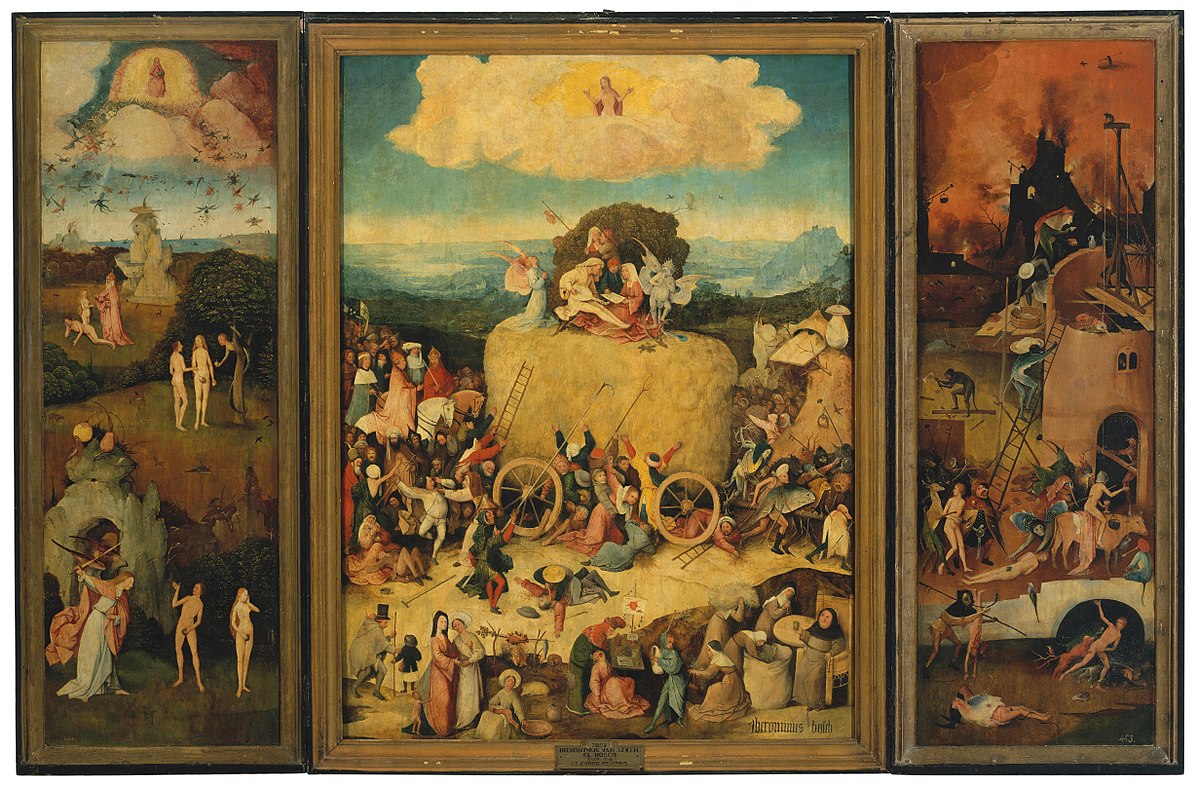
In 1512 Hieronymus Bosch painted the Haywain. In
the central panel Bosch shows humanity dragged along by
sin, following behind a haywain. Leading the crowds to
hell is the Pope and the Holy Roman Emperor. This echoed
the sentiments of the work of
Dürer we saw last week.
The Short-term causes of the
Reformation
The actions of
the popes at the beginning of the 16th century did much
to bring the Catholic church into disrepute. The popes were
involved in financial corruption and political
assassination, the word 'nepotism' comes from the papal
practice of this time of giving their nephews well paid
and influential roles in the church. The most notorious
pope was Alexander VI (1492-1503), who ended up wearing
a mask to cover-up his disfigurement by syphilis and
died, according to some theories, when an attempt
to poison a cardinal went wrong.
Nepotism
Nepotism is favoritism granted in
politics or business to relatives. The word
is derived from the Italian nepotismo, which
was used to describe the appointment of
relatives to influential position within the
Catholic Church.
But it was the actions of Pope Leo X
that would precipitate the Reformation. From the
powerful Medici family, nepotism saw him become an Abbot
at the age of eight and head of the great abbey of Monte
Cassino aged eleven. As pope, he enjoyed banquets and
processions, he had a pet elephant and spent
astronomical amounts on the arts. But his most ambitious
plan was to rebuild St Peter's basilica in Rome. The
money for this project was to come from the sale of
indulgences. As we have seen, an indulgence was like a
get-out-of-purgatory-free card, extra credit the church
could issue, acquired from all the good deeds of Jesus
and the Saints. In 1476, Pope Sixtus IV had
declared that it was possible to buy an indulgence for
someone already in purgatory. This proved to be a highly
marketable idea, especially in the hands of a master
indulgence salesman like Johannes Tetzel and his slogan
'When the coin in the coffer rings, the soul from
purgatory springs'.
The final important short-term cause of
the Reformation requires some explanation of why
Luther's criticisms did not lead to his execution.
Earlier reformers like Huss or just before Luther
Girolama
Savanarola, had been executed, so why not Luther? We
will examine the details of this later, but here it is
enough to recognize that by 1517, in some northern
European states, Luther's ideas were popular with
monarchs and princes who were looking to attain greater
independence from the political and economic demands of
Rome. By 1517, some of these rulers were prepared to
defend reformers like Luther who offered them a
spiritual justification for taking control.
Activity 2
1. Explain what is meant by long-term, medium and short-term
causes. Give an example from your own life to explain
the long, medium and short-term causes of an event that happened
to you.
2. Make a revision diagram of the causes of the Reformation using
the information given to you in this text.
The diagram should distinguish between short-term and
long term causes. It should be a full page of A4 in
size; it should be carefully designed, factually rich
and accurate.