Unit 3 - Lesson 5 - Mercantile
Capitalism and
Slavery
What can art tell us about the
past? (Again)
We can always begin our entry into a
particular time and place, though the art or literature
that the period produced. The gothic tympanum of
Amiens cathedral offers a brilliant insight into the medieval
vision of heaven and hell.
Albrecht Dürer's self-portrait encapsulates the
essence of humanism. So what of the Dutch Golden Age of
the 17th century, which sees the Netherlands become the
most important trading and financial power in the world?
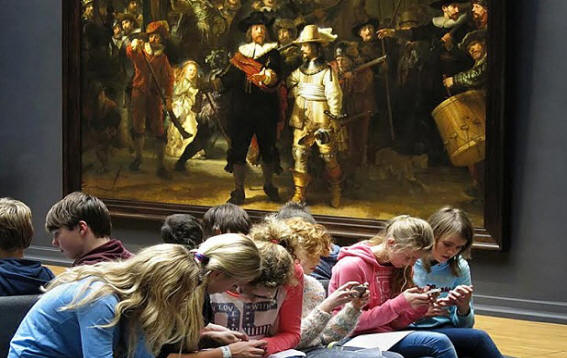
This is the most famous painting. This is the 1642 painting by
Rembrandt called The Night Watch shown in this
photograph at the Rijksmuseum in Amsterdam in
2016.
Khan Academy on the Night Watch
Whilst the Catholic world of the 17th century
embraced the extravagance of Baroque, which was excessive
in a deliberately Counter Reformationary way. The
Council of Trent decided to appeal to a more popular
audience, and declared that the arts should communicate
religious themes with direct and emotional involvement.
While the Protestants harshly criticized the cult of
images, the Catholic Church ardently embraced the
religious power of art. The visual arts, the Church
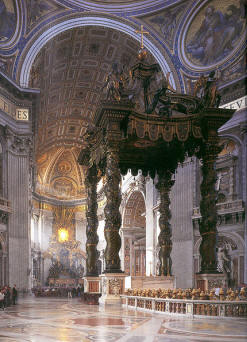
argued, played a key role in guiding the faithful. Gian Lorenzo Bernini's work on St Peter's in Rome is
typical of the awe inspiring power of Baroque.
Chair of St. Peter
Baldacchino of St. Peter's
Basilica
In contrast to Baroque, the art of the
Dutch Golden Age, was secular rather than religious. The
dominant themes are landscapes and cityscapes, scenes of
everyday life and portraits, lots of portraits. It has
been estimated that the rich merchants and townspeople
of the Netherlands commissioned over a million portraits
during the 17th century. And because of the influence of
puritanical Calvinism, most of these portraits look the
same. There is a lot of black, not much body and very
few possessions shown. The exceptions to this were the
group pictures which were much more relaxed, of which The
Night Watch is the most famous example of this. The
cost of group portraits was usually shared by the
subjects, often not equally. The amount paid might
determine each person's place in the picture, either
head to toe in the foreground or face
only in the back of the group.
Activity 1
Read the text above and watch the video.
1. Research some examples of Baroque art in Italy and
contrast it to the art of the Dutch Republic. The
Khan Academy is a very good place to start. Include
two or three examples from each tradition and explain
why they typify the two very different traditions.
2. What can The Night Watch tell
us about the mid 17th century Dutch Republic?
A glorious little film about Vermeer.
Why did the Dutch (and the British)
become so rich in the 17th century?
Socio-cultural explanations
As we saw last lesson, the Protestant
Work Ethic is a good place to start to try and explain
the commercial success and the origins of capitalism.
Watch the first 3 minutes and 26 seconds of this film for a recap.
In addition to the importance of
Protestantism (and to some extent perhaps because of
it), the Dutch Republic and the British Isles were also
home to some of the most significant scientific
innovators in this period we know as the 'Scientific
Revolution'. (see next lesson 6) The main reason for
this, was the freedom and protection these countries
provided for scientists to be left alone to experiment.
Both countries produced internationally significant
scientists like Anton van Leeuwenhoek (1632
-1723) in Holland and Isaac Newton (1642 – 1726) in
England. Both countries had institutions which
encouraged scientific thinking, like the
University of Leiden in Holland (1575) and the Royal
Society (1662) in England. And as we saw last lesson,
both countries (Holland first) allowed its citizens a
degree of individual freedom which had been hard won as
a result of war or civil war. Holland, with its
geographical proximity to a predominantly Catholic
Europe, became a safe haven for free-thinking scientists
and philosophers from all over Europe. Comenius
(1592 –1670), Descartes (1596-1650) and Spinoza
(1632 –1677) all found refuge in the Dutch Republic.
Again due to the Dutch climate of tolerance, book
publishers flourished. Many books on religion,
philosophy and science that might have been deemed
controversial abroad were printed in the Netherlands and
secretly exported to other countries. Thus during the
17th century the Dutch Republic became more and more
Europe's publishing house.
But socio-cultural explanations of their own
are never enough. (Remember PESC?)
Politically both countries enjoyed
significant advantages for the development of
capitalism. Firstly, both countries enjoyed a degree of
political stability after years of disruption. The Peace
of Westphalia in 1648, which ended the Eighty Years' War
between the Dutch Republic and Spain and the Thirty
Years' War between other European superpowers, brought
the Dutch Republic formal recognition and independence
from the Spanish crown. In England after civil war and
the Glorious Revolution of 1688, a period of political
stability followed. The nature of both political systems
also encouraged the development of capitalist business.
Neither the Netherlands nor England were absolute
monarchies dominated by the power of great landowners.
The Dutch Republic was highly decentralized, urban and
largely run by the leading businessmen in their
interest. Whilst in England, the Bill of Rights of 1689
set out the rights of Parliament, including the
requirement for regular parliaments, free elections, and
freedom of speech in Parliament. Parliament had
significantly weakened the power of the monarch.
But it was economically that the
Netherlands had the real advantage. The Low Countries
were favorably positioned at a crossing of east-west and
north-south trade routes, and connected to a large
German territories through the Rhine river. Dutch traders
shipped wine from France and Portugal to the Baltic
lands and returned with grain for countries around the
Mediterranean Sea. The Dutch had large merchant and shipping
fleets. In 1670, about ten per cent of Dutch adult males
were sailors; - the Dutch had more ships than England,
France, Germany, Portugal, Scotland, and Spain combined.
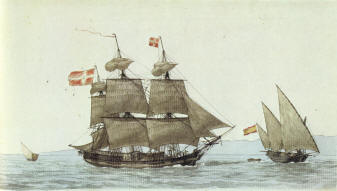
The Dutch built ships, the fluyt sailing ship (right), more
cheaply, more quickly and better than any of her
rivals.
Dutch religious tolerance also attracted
skilled workers, many of whom came to work in the new
cloth industries that increasingly replaced
expensive high-quality woolen cloth. In addition to the
mass migration of natives from the Southern Netherlands,
there were also significant influxes of non-native
refugees who had previously fled from religious
persecution, particularly Jews from Portugal
and Spain (see Unit 2), and later Huguenots from France. The Pilgrim
Fathers also spent time there before their voyage to the
New World.
The Dutch exploited the wind-powered
saw-mill (invented 1596) to turn timber into lumber more
efficiently than their rivals. The Netherlands were also
at the forefront of agricultural innovation. Instead of
periodically leaving land fallow, the Dutch rotated
crops (turnips, peas, and clover alternating with
grain). This enabled them to sustain high levels of
production without exhausting the land. Alternation of
"fodder crops" with grain also allowed the farmer to
keep more livestock and use their manure to fertilize
the land, so winning both ways. Despite its highly
efficient agriculture, the Netherlands still had to
import some grain, so densely was it populated. (See
Unit 5 - Industrial Revolution)
Activity 2
Read the text above and make a mind-map
or revision table to explain how the Dutch (and the
British) became so powerful in the 17th century. Make
sure to follow the PES-C approach outlined above.
East India Companies
The Spanish and Portuguese had a monopoly
of the East Indies spice trade until destruction of the
Spanish Armada in 1588 by the British, which permitted
the British and Dutch to seek their share of this
wealthy import business. The British formed the East
India Company in 1600. The Dutch founded two important
trading companies: - the Dutch East India Company
(1602), (Dutch: Verenigde Oostindische Compagnie
or VOC) and the Dutch West India Company (1621). These
private companies behaved like political states and
acted relatively independently of the Dutch and British
governments. They even had their own governments and
armed forces to defend the territories they controlled.
Tea, coffee, and spices were its most
important commodities. They were the first-ever
multinational corporations, financed by shares that
established the first modern stock exchange. Spices were
imported in bulk and brought huge profits due to the
efforts and risks involved and seemingly insatiable
demand. Spices, at the time, could only be found on
these islands. Spices such as pepper, ginger, nutmeg, cloves
and cinnamon could bring profits as high as 400 percent
from one voyage. To finance the growing trade within the
region, the Bank of Amsterdam was established in 1609,
perhaps the world's first central bank central bank.
Amsterdam's dominant position as a trade centre was
strengthened in 1640 with a monopoly for the Dutch East
India Company (VOC) for trade with Japan through its
trading post on Dejima, an island in the bay of
Nagasaki. From here the Dutch traded between China and
Japan and paid tribute to the shōgun.
The tension was so high between the Dutch and the
British East Indies Trading Companies that it escalated
into at least four Anglo-Dutch Wars between them:
1652-1654, 1665-1667, 1672-1674 and 1780-1784. By the
time of the last of these wars Britain was the dominant
economic power and was on the verge of launching the
second stage in the development of capitalism, the
industrial revolution. (unit 5)
Activity 3
Read the text above and watch the film.
1. The VOC was described as a state
within a state, explain what is meant by this and why
VOC's long-term business plans, low interest rates
and Dutch attitudes to investment and shares made for a
successful business. (Video up to 8m15)
Inherent problems of capitalism -
part 1 (monopolies)
2. The VOC was established to help the
Dutch gain a monopoly of the spice trade. What is meant
by a monopoly, how did the Dutch achieve this monopoly
and what were the consequences? (Video from 8m15)
Inherent problems of capitalism -
part 2 (boom and bust)
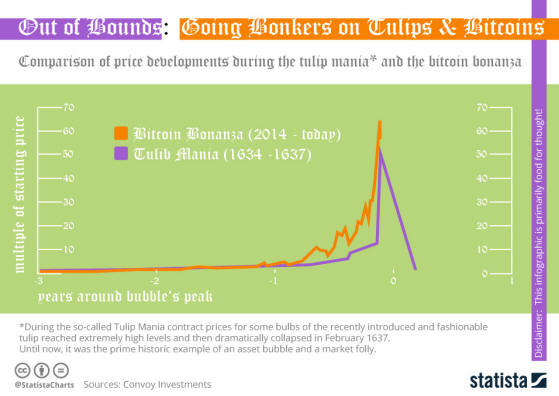
The Great Tulip Bubble, 1636-37
Not all Dutch investment was solid and sensible. Tulips
were introduced from Ottoman Turkey and grown in the
Netherlands during the early seventeenth century. The
beautiful flowers served as an extravagant display of
wealth and taste for prosperous Dutch burghers. Suddenly
in 1634-35, there was an explosion in demand and prices
soared. Particularly rare and beautiful bulbs fetched
thousands of florins, and speculators invested in "tulip
futures" - buying the flowers before they had even grown
in the fields. The speculative bubble burst abruptly;
prices began to fall and investors were left holding
worthless assets bought with borrowed money.
To restore some sort of stability, a government
commission finally ruled that any contract could be
terminated by paying 3.5% of the purchase price.
(https://en.wikipedia.org/wiki/Tulip_mania)
Inherent problems of capitalism -
part 3 (exploitation)
The
Slave Trade
As we saw with the
Dutch East India Company in the Banda Islands example,
early European capitalism, backed by the armies of the
state, forced weaker trading partners into uneven trade
agreements. The biggest profits depend on keeping costs
down and the biggest cost is human labour. What these
early merchant capitalists tried to do was pay as little
as possible for labour. The cheapest labour of all is
slave labour.
The transatlantic slave trade was responsible for the
forced migration of between 12 - 15 million people from
Africa to the Western Hemisphere from the middle of the
15th century to the end of the 19th century. Over time,
European demand for spices was replaced by a demand for
luxury commodities - sugar, coffee, chocolate, tobacco -
luxury because they are not essential to life. Probably
no more than a few hundred thousand Africans were taken
to the Americas before 1600. In the 17th century,
however, demand for slave labour rose sharply with the
growth of sugar plantations in the Caribbean and tobacco
plantations in the Chesapeake region in North America.
All the major European powers were involved in this
enterprise, but by the early 18th century, Britain
became the world's leading slave trading power. It's
estimated that British ships were responsible for the
forced transportation of at least 2-3 million Africans
in that century. The wealth generated by slavery not
only built the great port cities of Bristol and
Liverpool, it also laid the economic foundation, the
capital, essential to launching the British industrial revolution
that made the modern world. (Unit 5)
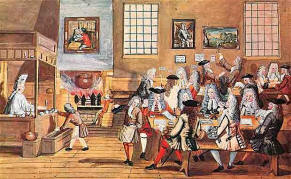
An early 18th century coffee house in
London.
The majority of kidnapped Africans
were not already slaves in Africa. They were free people
who were kidnapped to provide the labour that the
European powers required to build their colonies in the
Americas. The transatlantic slave trade is sometimes
known as the 'Triangular Trade', since it was
three-sided, involving voyages:
from Europe to Africa
from Africa to the Americas
from the Americas back to Europe.
It's generally seen as a 'trade' since it revolved
around transactions, or a form of exchange, between the
African sellers of slaves and the European buyers of
captives.
The Atlantic passage (or Middle Passage)
was notorious for its brutality and for the overcrowded,
unsanitary conditions on slave ships, in which hundreds
of Africans were packed tightly into tiers below decks
for a voyage of about 5,000 miles (8,000 km). They were
typically chained together, and usually the low ceilings
did not permit them to sit upright. The heat was
intolerable, and the oxygen levels became so low that
candles would not burn. Because crews feared
insurrection, the Africans were allowed to go outside on
the upper decks for only a few hours each day.
Historians estimate that between 15 and 25 percent of
the African slaves bound for the Americas died aboard
slave ships.
Detail of a British broadside depicting
the slave ship Brooks and the manner (c. 1790) in which
more than 420 adults and children could be carried
onboard.
Activity 4
Read the text above and watch the extract from the
Steven Spielberg film Amistad. The Amistad was a
19th century slave ship. Be warned the
video contains some shocking scenes. Make a summary list
of the conditions on board for African slaves on the
middle passage. Can you suggest some reason why it took
until the 19th century for European powers to finally
ban the slave trade?


_4.jpg)